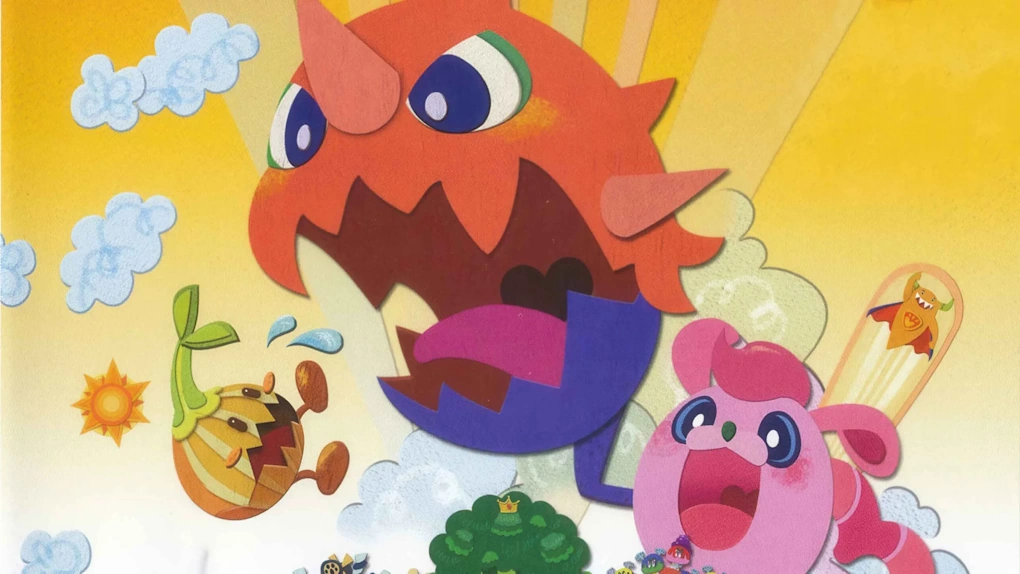
A Katamari-like from the actual Katamari developers, those Now Production contractors who toiled to get Keita Takahashi’s vision off the ground.1 Munchables twists the “roll up stuff, get bigger, roll up bigger stuff” loop from Katamari into a game all about eating, where the mute, spherical protagonists chomp through waves of pirate/alien/frankenfood creations, progressively inflating after each set of meals. The character’s size is unambiguously labeled with a level number, with enemies larger than yourself having a similar label to illustrate who exactly you can eat at any given point. These larger enemies can be bumped with a dash attack that splits them into smaller enemies, although if the difference between you and the enemy is vast enough, each of their component sub-enemies may still be larger than you. Recursively repeating the split mechanic unveils levels built around flooding the field with bite-sized enemies and eating as many as possible before they reassemble into their larger forms.
These large swaths of enemies props up the game’s chaining mechanic. Eating an enemy starts an implicit chain timer that replenishes with each additional enemy eaten; when the timer expires, the number of meals counted from enemies eaten during the chain will more or less double. As synergistic as the decomposition and the chaining are, their combination puts a bit too much emphasis on decomposing enemies on-sight rather than waiting to approach their size and eat them normally, at least in a vacuum. However, in the first non-tutorial levels, the Katamari flair emerges thanks to strategic, dense enemy layouts. These are structured as large arenas of separated zones, each locked behind edible barriers with level requirements, opening the door to freeform navigation and backtracking. Larger enemies are placed in groups that will overwhelm a player that tries to decompose them all, making return visits to these areas a necessity. Similar to how Katamari lets the player reason about the optimal size to grab a set of items at once, here one can plan inter-zone chains by timing a level increase mid-chain to jump through a barrier and scoop a new set of enemies.
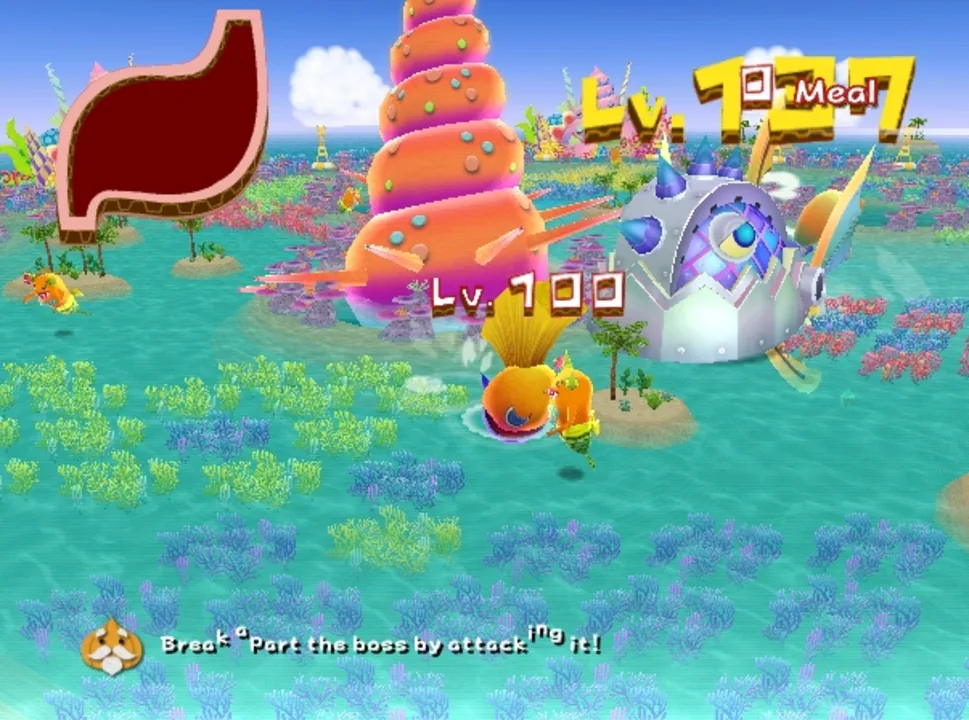 The boss battles play with the primary concept by having very typical platformer ways to defeat it (in this boss’s case, it can be lured to smash into the conch shell, breaking it into pieces) while also featuring a level gauge identical to any other fight. The player can choose whether they would like to stall and get bigger or actively make the boss smaller; neither case ends up particularly interesting, however. [src]
If the game persisted in this mold it would be a success; even without particularly interesting movement or physics a la its predecessor, there’s a buffer-able, charge-able dash chomp used to link enemies in a chain, which adds a comfortable rhythm to the experience. Unfortunately, the level designers start orchestrating the level setpieces much more intimately, clamping down the routing in the process. The progression quickly devolves into linear gauntlets, jettisoning the potential for inter-zone chains and replacing it with quick bursts of enemies with ample downtime in between. These in-between sections get muddled with switch “puzzles” and other tired gimmicks that continually throw the Katamari loop out the window. The aforementioned issue with the decomposition/chaining synergy is exacerbated, because there’s never a reason to not decompose big enemies as soon as you see them, making the linearity of the levels even more apparent. When the game veers into actual platforming, it’s even more appalling: there’s virtually no mechanics here to support it outside of mild air stalling whenever you chomp. A gently interesting system is completely nullified by level design drawn from the wrong type of game.
-
Although a quick Mobygames check lets us know that just as many of the developers on this particular title were johnny-come-latelies who started on Beautiful Katamari. Many of this cohort worked on the Klonoa Game Boy Advance titles instead. ↩︎
Comments
You can use your Bluesky account to reply to this post.