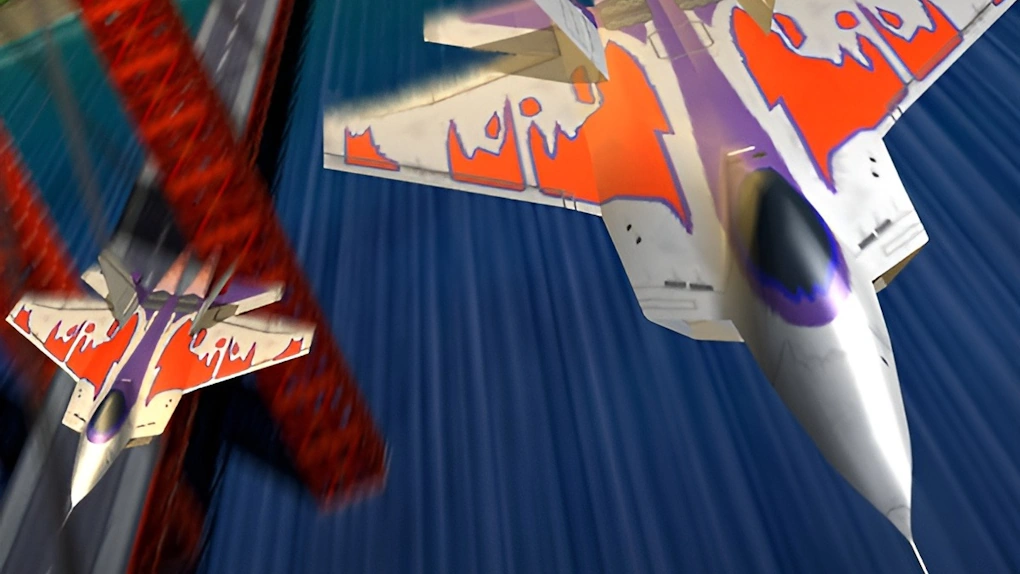
Retrospectively speaking, Ace Combat’s1 rough-hewn edges might appeal to those turned off by how quickly the series streamlined starting with its immediate sequel. Starting Ace Combat’s hard mode plops the player into an unmaneuverable tin can that explodes upon contact with a single missile, and the plane selection only incrementally improves its quality from there. Broadly speaking, the most useful planes are split between durable hunks of junk and fragile ships that pivot on a dime, leaving the player to decide between the least bad choice for a given objective. Both of these give the simplistic dogfights and bombing runs a distinct flavor. The former makes downhill approaches a necessity to build up enough speed when avoiding surface-to-air missiles surrounding a drop zone, while the latter turns stray gunfire into a legitimate danger. The decisions here (along with a bevy of stealth planes and other more unorthodox choices) make experimentation with each mission much more useful compared to later titles, which drown the player in extremely useful all-rounders.
Although the basic mission objectives rarely vary, there’s still a surprising attention to detail on their structure and content. The detailed cityscapes of Ace Combat 2 and Electrosphere are absent due to technical limitations, and instead desolate steppes and seaboards dominate. Scripted elements rarely drive mission progression in favor of natural geography sheltering units or vehicles that naturally join the action when the player draws near. In one mission, ground targets lie within a niche cut into an inselberg; in another, a grassy dome seabase flanked by anti-aircraft warships has targets sequenced in a chasm joining ports on each side. Series-staple canyon runs start here in two different forms, although they’re relatively spacious, and their final targets are non-existent or easy to hit. Although these never dip into the unclear passages or tight labyrinths of later entries, other missions do leverage sight and radar as key facets. A strike upon a network of oil refineries in a desert relies on the short draw distance to hide each facility, which must be traced by following pipelines jutting through the sand. In others, stealth planes circle you off-radar, visible only as V-shaped black lines in the distance. With a friendlier plane selection these might feel slight, but the peculiarities of each mission and their enemy composition (ground vs. air targets, enemy plane characteristics, tight passages vs. wide-open spaces) amplify the distinct, imperfect qualities of each plane.
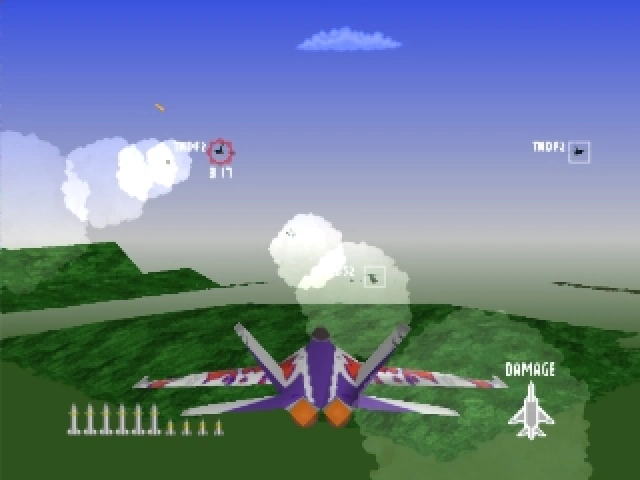 The faux-infinite planes and simple geometry call to mind Namco’s System 11 games, in stark contrast to the dense atmosphere and bustling cities of the sequels. [src]
There’s emphasis around your overall plane roster as well with the permanent loss of a plane upon its destruction.2 To some extent this cultivates a “one-run” structure, which congeals with the brief runtime and ability to skip around half the missions, but this makes the beginning of the game with its one-hit kills and limited plane roster a major reset point; the developers added free saving regardless, so they don’t seem that wed to the idea. Still, the branching mission map has the appeal of emphasizing locality by having the player capture bases in-narrative. Each new base opens up new opportunities around it, with the option of returning to any other base to expand the conquest in a different direction. This grounds the missions in a particular time and space, especially for missions that repeat a given base map once for its capture and once later for its defense. Finally, tucked away in the top-right corner of the map is a waterway housing a massive aerial fortress the player must whittle down in an all-out boss battle. Choosing how to approach and whether to focus on its engine and bridge versus its weaponry has a unique combat flavor that the series would abandon for several entries afterwards.
-
I’m using the Japanese title here since the rest of the series switched to this title and to disambiguate it from its arcade predecessor Air Combat. ↩︎
-
There’s at least one mission you can fail while keeping the plane (the VIP escort mission), which has the strange side effect of making it a money grind point, since you’re still paid out for targets shot down even if the escort is destroyed. Not that you’ll need it, since the missions pay very handsomely. ↩︎
Comments
You can use your Bluesky account to reply to this post.