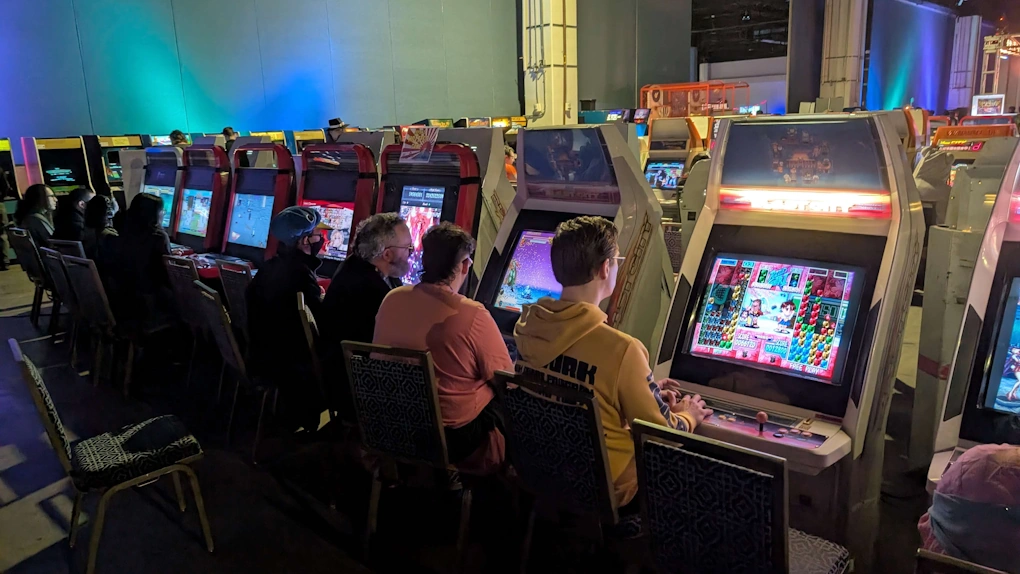
what do you think makes something “arcadey” since that’s a label i see getting thrown around a lot
I went back to a 2023 Discord conversation on this topic and pulled an old definition I had made to compare to my current thoughts:
- Scoring system as a key extrinsic motivator
- Linear progression
- Short run-time
- Time-bounded
- Repetitive iteration on small group of mechanics
These reflect the thoughts of someone who, having loosely reverse-engineered the arcade concept from its descendants, only dimly exposed to the arcade itself as a form and method of play, could only peer back through a slit to the material reality that held those experiences together. Hence the specificity of the mechanics at play, hence the prescription on their length and structure. But this is ultimately a definition of what a particular type of arcade-inspired game looks like, ignoring the other aspects of the arcade experience and the fundamental reasons why their mechanics evolved in such a way. Identifying these fundamentals would clarify the qualities of an “arcade-y” (or arcade-style) game.
Shared Platforms for Play
The advent of processor technology originally manifested as large-scale installations shared by a group of people; personal computing didn’t exist until the early ’70s and wasn’t mainstream until the early ’80s. Powerful hardware suited for useful tasks only existed at prices and inventory suited for multi-person use. Arcades are a prime example of this: top-of-the-line graphics and processing too expensive for home use thrived in a shared environment, where a several-thousand dollar machine paid for itself via the pocket change of many people playing it. Noting this gives us a comparison point for games from the arcade environment to games from the mainframe environment, based on a notion of a shared platform.
A shared platform places a game in a context where it is assumed that a single instance of said game will be played by multiple people, either concurrently or asynchronously. The most obvious mechanical implication of this is literal multiplayer, whether cooperative or competitive, as seen in multi-user dungeons or early deathmatch games like Maze. Many arcade games followed suit. Multiplayer integration is arguably a primary driver of dynamism in many early arcade games in the transistor-logic era (especially if we include electromechanical games), where designing artificial intelligence for dynamic adversaries was too difficult to be practical.
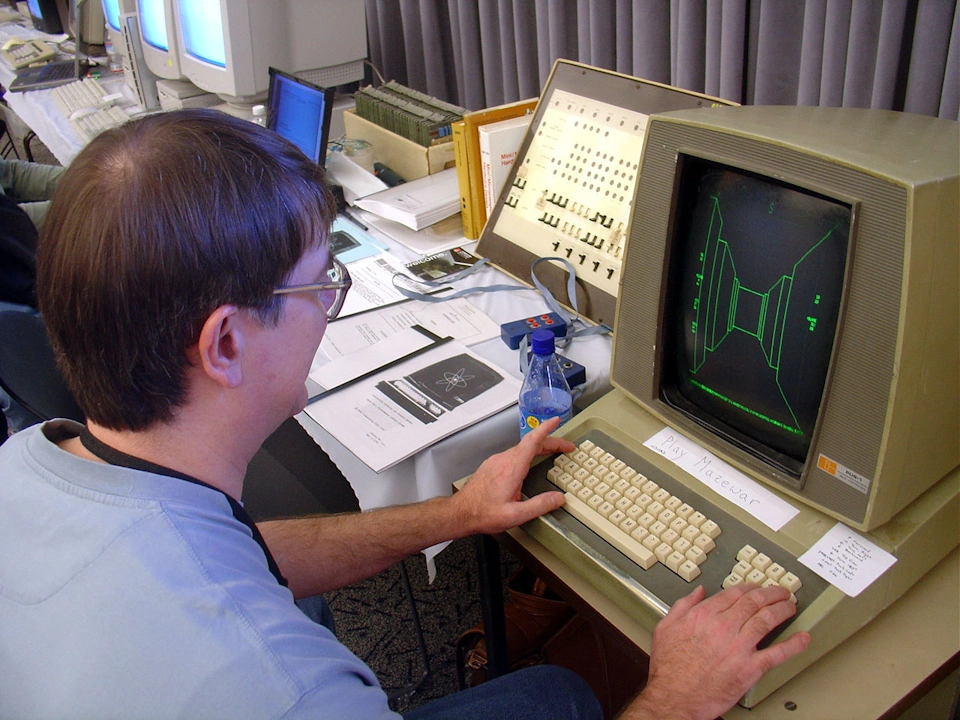 Mainframe games like Maze laid the foundation for future multiplayer deathmatch games in the early ’70s. [src]
When players interact asynchronously, however, different effects of the shared platform emerge. In asynchronous competitive games, those who wish to compare their gameplay may want an objective measure of their performance. Hence, a scoring system emerges. While scoring is not unique to the arcade, pre-dating the modality by centuries at a minimum,1 computing platforms offer a particularly effective method to produce robust scoring systems; crunching numbers is their primary function, after all. Mainframe games featured score prominently for similar reasons, from early examples like Hamurabi to unusual places like Colossal Cave Adventure, which required in-game points to reach its conclusion. Just as scoring concepts from arcade games bled into console titles of the time, mainframe scoring bled into personal computer games: see Infocom’s interactive fiction titles of the early ’80s, which still prominently featured score despite being nearly divorced from the original shared platform context.
Additionally, a shared environment fosters circulation of information between players. The elliptical, uncommunicated mechanics of mainframe games and arcade games alike functioned as glue in an environment where tricks, strategies, and secrets spread organically. In mainframe games, in-jokes and concepts amongst the player base evolved into in-game mechanics, creating bi-directional exchange between players and designers. In arcade games, the obscurity of solutions and powerful items in games like Druaga and Pac-Land was matched with cabinet-tethered notebooks for players to record their findings. As console and PC games featured the same dynamics, they only manifested in shared spaces external to the game itself: a schoolyard or cafeteria, for instance. Arcade and mainframe games magnified the effect thanks to the game’s intrinsic relation to the shared space.
What the arcade held over the mainframe was the legitimacy of its use of space, in that the space was dedicated to the game and, more broadly, to entertainment. Where mainframe games were played and distributed furtively, interfaced through visual systems not built to support them, arcade games proudly displayed themselves in spaces controlled by them, often housed inside of cabinets custom-built for their operation. The repercussions of this distinction created the primary rift between mainframe and arcade games. While some mainframes had accepted gaming activity, they still were often restricted to employees or students of an academic department. However, even when mainframe games were under attack by system overseers,2 the amount of off-hours time one could sink into a mainframe game let their representative genres expand structurally, building the base for what blossomed into expansive computer role-playing games and simulations. Additionally, the platform by convention thrived on open-source access and free distribution and modification of code. When the games were not seen as commodities, they gained these privileges for the player. Arcade games would not be distributed and played under the same conditions.
Credits
The owner of an arcade cabinet offers it for “rent” to players. By giving games legitimacy in the space, one can control their usage with intentionality, as compared to the erratic play sessions of one running a mainframe program.3 Hence, the concept of a “credit” emerged, where small coinage (either fiat currency or issued by the arcade) is used to reserve a play session. What a play session is in this context was left up to the determination of the game designers.
The context of the shared platform necessitates that the play sessions be time-bounded in a broad sense, but the strategies for how to accomplish this varied from game to game. While some games were literally time-bound by an internal timer, others, such as maze games, featured a dynamic mechanical force to snuff out a player given enough time. Both of these strategies, among others, mean the games are self-terminating, as in no instance would an idle player survive indefinitely; their session would be clipped to allow the next player to step up.
 Beatmania IIDX automatically ends a stage when fifty notes are missed with no input in order to allow other players to start a fresh game. [src]
Consensus quickly determined that session length should correlate with the player’s skill. This had the side effect of many early titles, which emphasized score and infinitely looped, losing their intended self-terminating properties at high levels of play. The consensus has shifted towards fixed amounts of content being available with a single credit: racing on one stage, playing three songs, or literally buying a fixed period of time to practice. These often mesh with the old consensus – spend more time in the race by reaching checkpoints, play an extra song for scoring high on previous songs – but fundamentally they flatten the structure or segment it so thoroughly that experiencing all of the content on a single credit is impossible. Already the latter modality had dominated the arcade to such an extent by the late ’90s that Crazy Taxi producer Kenji Kanno felt that the traditionalist, score-driven modality present in that game was novel.4
One solution for the issue of infinite looping led to total content structures expanding in variety while contracting in volume.5 Separate areas of games in particular genres became increasingly differentiated (especially as memory constraints allowed) and moved towards loose narrativization, contextualizing progression through spatial presence and textual exposition. This evolution towards narrative closed the loop by adding explicit endings, providing ultimate self-termination in the event that second-to-second mechanics could not finish the job. At the same time, this reconstitution of arcade structure, where progression outweighed score, begged the question of whether a game as a narrative product should only be witnessed by those with the skill to proceed on a single credit. Thus, these titles revised the play session concept to persist through multiple credits. The idea of a play session tied explicitly to a single credit carried on in the cultural convention of the “one credit clear” (or 1CC), which continues to socially signify true expertise. In many cases, achieving this carries in-game prestige as well, presenting additional content or preserving score for those who do so.
Other genres have not become narrativized in the same way, or they use hybrid structures. Prop Cycle, for instance, features both a linear stage-by-stage “story mode” alongside single-level score modes. Regardless, no matter the structure, each major arcade genre formed around a time-rent system centralized around credits. The mechanical ramifications of this manifest in many different ways, although each generally eschews unbounded exploration in favor of either strictly linear gauntlets, flat structures of parallel, bite-sized scenarios, or some combination of the two. And each invariably attempts to self-terminate, whether the original time-rent system is in place or not.
Machinery
Arcade cabinets advertise themselves; as they collaborate to fill the arcade space, they compete for continuation in the space, to have the greatest gravity to attract consumers and thus prove their value to the owner of the space. Maximizing gravity increases relative value, both between machines in an arcade and between arcades, and the method that many manufacturers undertook to increase this required the physical presentation in the space to mutate into forms that would surprise the customer. Thus cabinets with unusual control schemes, force feedback, multi-screen views, surround sound, and other tricks emerged in the heyday of the arcade. These all exist due to a need for spectacle.
This aspect of the arcade-style designator is notable in that it has persevered in arcades past the expiration of most of its contemporaries. The primary long-form skill-acquisition games that predominately exist in arcades today, rhythm and racing games, thrive on control schemes that are cost-prohibitive to the average consumer in their home. These have morphed to match the times, primarily subsisting off of elaborate content allocation systems that beg players to return again and again: character customization, scenario unlocks, statistical progression for mechanical advantage, and other methods. Other games, having long since lost the technical edge to modular GPUs, have developed totalizing experiences distantly similar to the amusement machines of 30 years prior.6
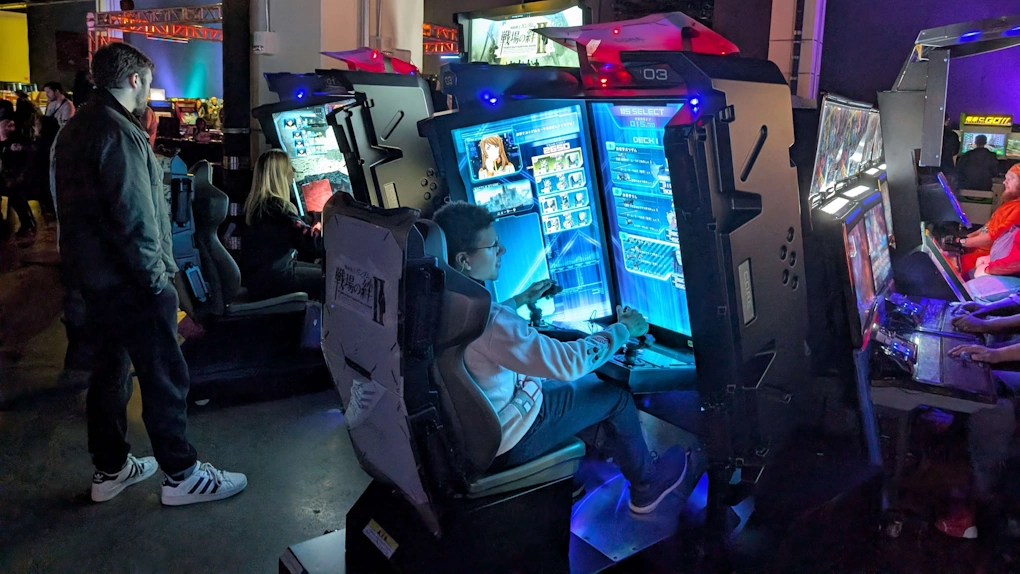 Games like those in the Kidō Senshi Gundam: Senjō no Kizuna series draw players in based on their immersive monitor setups.
Novel control schemes in particular informed a particular arcade focus on exaggerated replicas of real-life activities. Vehicles from skateboards to trains have an obvious foothold, as do weaponry, beyond only pistols and extending to the sniper fantasies presented in Silent Scope and Golgo 13. These naturally have direct mechanical impacts on games built in this model. Rhythm games as a whole have built much of their complexity around control surfaces that can never be completely covered by a player’s hands and appendages at once; although Bemani’s early games were crude representations of reality or completely abstract, their more realistic instrument-based titles such as Drummania and Keyboardmania deftly exhibit this principle, just as their real instrument counterparts do. While some of these titles may translate to a home experience, their key aspects of play exist downstream from the control surface in some form.
In the heyday of the arcade, where their technological prowess trumped every alternative, spectacle could be generated from bleeding-edge graphics and performance. In this particular mode of spectacle, the real-time game reigns supreme, and real-time genres have dominated the arcade for this reason. Slower turn-based games can scarcely demonstrate the seamless rendering that powerful hardware offers, and with the added wrinkle of time-bounding as mentioned in the previous section, they are non-viable on two separate counts. When arcade games stray towards minimal, segmented input mechanics, they still often feature some sort of real-time reactivity or simulation, such as granular aiming in games such as Puzzle Bobble and Neo Turf Masters and the physics they visualize after a shot. The push for spectacle privileges the real-time game just as much as it would a novel control surface.
Conclusion
With the above in mind, three arcade fundamentals stick out:
- Arcade games are a shared platform. This encourages competitive and/or cooperative play, synchronously or asynchronously.
- Arcade games conventionally operate on a time-rent system. Mechanics reinforce this by being self-terminating.
- Arcade games attract consumers via spectacle. This was traditionally created through novel control schemes and/or appealing real-time graphics and gameplay.
Having extremely high-level fundamentals such as these, which feature little information on specific mechanics, provides a basis for the many, many disparate types of arcade games that exist. Likewise, the goal is to associate existing mechanics back to these fundamentals. If we look back at the list from the top of the article, the mechanics described are not universally applicable and yet unconsciously draw from these fundamentals. Score may not feature in every arcade game, but as a shared platform that encourages competition, objective measures of success are an intrinsic aspect of arcade games, whether via score, time trials, or direct head-to-head competition. Many arcade games do not feature linear progression, but some use it to enforce strict forward momentum to reach self-termination, just as a deliberately nonlinear game like Crazy Taxi instead enforces self-termination via a limited objective base and a multi-timer system. The only one of this original list that lacks this tie is the “repetitive iteration,” which also has obvious counterpoints in minigame-based experiences like Rhythm Tengoku or the Numan Athletics series.7 Regardless, arcade-style games should have mechanics that respond to and fulfill these fundamental requirements.
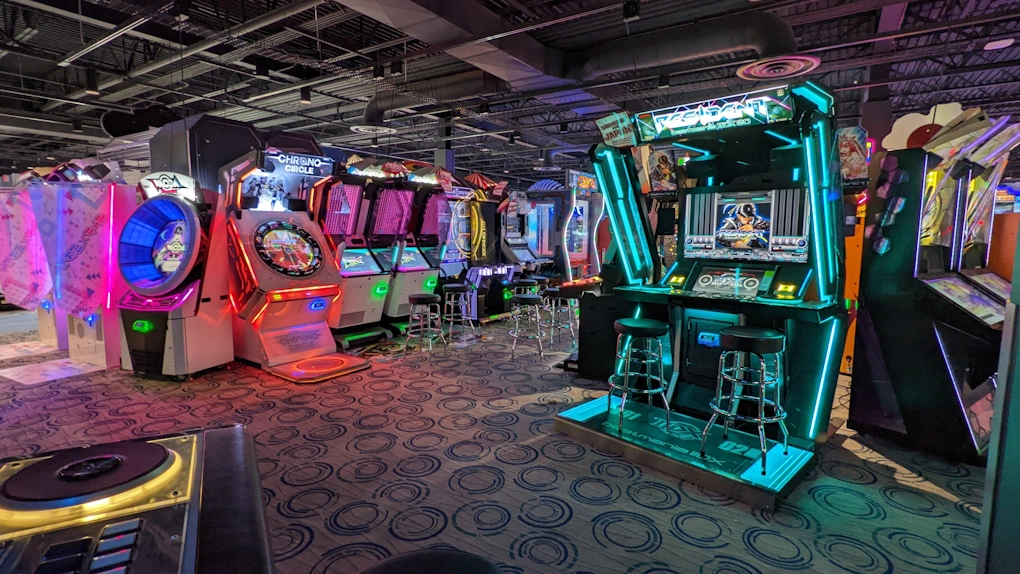 Round1, although swamped with redemption games and claw machines, have official Bemani network integration and an excellent overall selection of rhythm games. The chain has roughly doubled their locations in the United States since the pandemic and opens several more each year. [src]
This conversation is more interesting in the wake of a growing resurgence of interest in arcade design, specifically in the west. Some brief reasons why this may be occurring, each conjectural to varying degrees:8
-
Round One Entertainment Inc. expanding rapidly across the USA with a strong selection of official, modern arcade offerings for skill-based genres such as rhythm, racing, and fighting games.
-
The decline of Japanese arcades leading to mass resale of used machines, resulting in a “gray market” in the west for said machines that have ended up in many computer cafes, retro game stores, and other independent arcades.9 Many of these locations use flat-rate entry with free-play cabinets that are ideal for practicing their games.
-
Ease of use for arcade game emulation thanks to robust community efforts.
-
Speedrunning as the dominant “hardcore” play-style plateauing and players looking for other high-skill-ceiling outlets (as shown by GDQ increasingly showcasing non-speedrun superplay content).
-
Likewise, the decline and oversaturation of popular high-skill genres such as Soulslikes, character-action games, and roguelites creating an interest in games that either lack the weakest qualities of those genres and/or represent a more “pure” play experience.
Some of the conditions help outweigh the explicit references to the elements of capitalism littered throughout this article. The artistic or creative aspects of arcade games may have arisen from a particular commodity model within capitalism, but they can equally exist outside of it, and thus the mechanical foundation they have laid for us persists. Self-termination, for instance, while obviously a solution to the need to rotate players on a cabinet, has purely mechanical ramifications that deeply affect decision-making and positively enhance game design. The material reality is discussed in detail here only to offer an explanation on how these elements of arcade-style games arose, not to state that their dynamics can only exist under those exact material conditions.
In some ways, the current material reality offers the perfect opportunity for these ideals to persist. The rise of online gaming effectively turned every gaming platform into a shared one, opening up online leaderboards and matchmaking in the process. The comparison seems like it is not lost on developers, who have used simulacra of arcade settings as online waiting rooms. Likewise, brick-and-mortar arcades increasingly offer online play, giving an alternative to in-person interaction. It is easy to imagine “arcade-y” fundamentals persisting and evolving with conscious effort, even as the original material reality has changed significantly.
Thanks to HotPocketHPE and Raph for helping me edit this article.
-
In reference to the prior point about electromechanical titles, pinball featured physics-based dynamism and was thus naturally suited to asynchronous competition. Scoring systems from those games were certainly a natural inspiration for those of later arcade games and mainframe games; Ray Wood, developer of dnd, mentions them directly for inspiring dnd’s scoring in this interview. And it is easy to imagine that pinball directly drew scoring concepts from traditional asynchronous games in the lawn and target sports genealogies (bowling, darts, billiards, etc.). ↩︎
-
Dave Lebling mentions in this interview that Maze was so disruptive at MIT that a background process called the “Maze Guncher” was written to automatically crash running instances of the game. Likewise, in the aforementioned interview with the creators of dnd, Wood states that a major reason for the design of the game was that the popular dungeon crawler pedit5 was frequently deleted by the Southern Illinois University PLATO administrators. As Wood and co-creator Gary Whisenhunt were administrators themselves, their own software was safe from being deleted, and so they wrote a game of their own as a reliable offering on the school network. ↩︎
-
The mainframe is monetized in a similar way; anyone who has bulk ordered compute for a distributed computing research platform or something similar has experience with this. From a research perspective, however, a local mainframe is likely funded by a grant that has nullified its cost to begin with, so the sharing model is often as-needed or sorted in a non-monetary manner. ↩︎
-
As he points out in this interview: “The arcade version of Taxi tried to create a new style instead of the usual arcade experience, which is 100 yen per 3 minutes in Japan. We started the project with the concept that we’d give players more time to play as they improved their skill in the game.” He considers the latter a “home game” mentality, which I broadly do not agree with (though I understand what he means by it), but the explicit standard exchange in the cabinet “rent market” he cites here is precisely the modality that has calcified in modern arcade games. ↩︎
-
With regard to my thoughts here, I assume this is one of the reason that true endless modes in action-puzzle titles quickly drifted to the home market, where terminating play was not a material issue. ↩︎
-
When I say “amusement machine,” I mean here machines like the AS-1, or motion simulators/“large attractions” in general. ↩︎
-
One could call the limited input spaces of these effectively a “small set of mechanics,” (e.g. all the minigames are about mashing the buttons or timing them in a specific way) but by that point we’re at a level of abstraction beyond mere arcade games; you could describe many, many games this way. ↩︎
-
Unfortunately these bullets are very USA-centric, since that is where I live. But presumably the interests and material reality of Americans have contributed to the spread of arcade ideas throughout the English-speaking world. ↩︎
-
The latter has, to some extent, been aided by the separate emergence of adult-oriented arcades that make their money from alcohol. While it’s common that these are focused on easy-to-maintain retro cabinets and lack imported machines, they still have aided enthusiast arcades as well. For example, a local “barcade” in my city had, at one point, the only operational Dance Dance Revolution cabinet within an hour’s drive (it was an older Extreme cabinet), which led to the arcade becoming a meet-up spot for rhythm gamers in the area and intermingling them with non-enthusiasts present for other reasons. Multiple employees at this location used experience gained maintaining and purchasing arcade cabinets there to open an enthusiast-oriented location nearby, which evolved into a full-fledged import arcade in a small warehouse. Virtually every rhythm game player who frequented the barcade then switched to the enthusiast arcade, these people advertised the spot by word-of-mouth, etc. ↩︎
Comments
You can use your Bluesky account to reply to this post.