The first nuance of Tetris that a new player will comprehend is the role of each piece. The unique sides of each tetromino synergizes with particular holes in the stack and affects the future stack’s shape: some flatten, others create peaks, some bridge gaps, others divide. Few Tetris variants stretch what this entails quite as far as Tetris – The Absolute: The Grandmaster 2 (lovingly referred to just as The Absolute Plus, or TAP). A Swiss Army knife piece like the T, at the drop speeds TAP eventually induces, suddenly becomes a death trap if there’s a gap in the stack right below the drop point; likewise, I-pieces and their inflexible rotation quickly ends runs without stacking with it in mind. Tradeoffs form in this environment. Covering holes, while virtually never an issue in the later Tetris Guideline games thanks to held pieces and gentler speeds, has strategic merit here when compared to overextending vertical towers or removing flat landing spots from the stack. A willingness to stomach risk and non-optimal outcomes gives TAP a distinct character.
The stack itself is personified in the mind of the player; what it whispers depends on their disposition. Stacks demand a perfect balance between even and rugged gradations, flat enough for an O-piece with divots for Z- and S-pieces. In practice, this may manifest as a long slope from the left side to the right, dividing the surface into two-or-three column-wide steps for placement. This suggests a skim-heavy style, where pieces can be eliminated as soon as they are dropped by suspending them over the well and connecting them to a step, removing the connected line and flattening the whole stack in the process. A simple strategy, but one that requires delicacy: distribute falling pieces unevenly between steps and their height differential will make them unable to support pieces that would connect them, such as the hook-like L-piece. Alternatively, leaning on skims as an easy button wastes valuable time,1 especially when the well factors into it. The well essentially drains the pieces that create unwanted verticality – the I-, J-, and L-pieces – but self-regulates in doing so, as clearing lines with those pieces lowers the well. Without enough well, those pieces may create awkward spires when dumped onto the stack, artificially dividing sections with no landing spot provided at the top of their spindle.
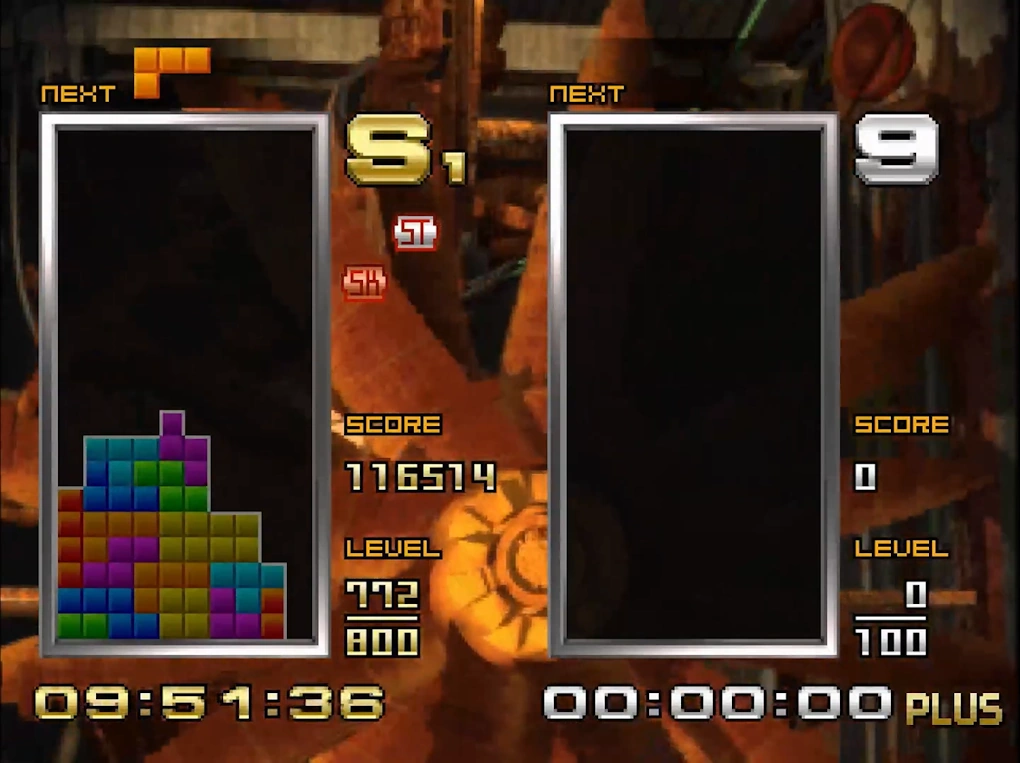 The hole on the left side is problematic here; a little nub in the fifth column is complicating movement for pieces that land in the sixth column on rotation. I-pieces, which drop flat, can use buffered rotation (known as the Initial Rotation System) to drop in a line, which would happily fill that left hole, but the asymmetric rotation system has it drop in that sixth column. Only a J-piece will comfortably fit in it now. [src]
The well is just the most viable application of a certain precognition of upcoming pieces, hedging the stack’s structure against the whims of the random piece generation. TAP is arguably the final major Tetris to truly randomize pieces without using a “bag” or “pool” system.2 If a piece is picked that was also picked in the recent history, the game will repeatedly attempt to pick another piece, but after several attempts it will use whatever piece given. This creates some level of predictability, as there are a subset of pieces that are more likely to appear at any given time, but TAP does not guarantee that these pieces will appear in the near future as the Guideline games do. A drought of a given piece may occur without any rerolls happening. Pesky one-piece-only holes, such as the infamous two-deep holes with a lip on only one side, are potentially devastating in this context. This plays back into the tolerance for risk: how many pieces you’re willing to place before settling on covering on of these holes shapes your playstyle, whether you’ll wait until death for the right piece or cover something questionable as soon as you see it.
At full gravity, the stack must itself funnel the pieces to their next destination rather than only containing them. Inducing speed is not an instant mechanic (outside of T.A. Death mode), as TAP uses a somewhat traditional difficulty curve to its speed increases. However, this is not conceptualized or presented as a “mechanic”: the Arika developers find any variable at the margins and tune it to tighten play. The linear speed of the blocks falling is only one of these variables, along with the frames before a stationary piece locks in place,3 the frames before dropping a new block, and the animation length of the line clear. Tiny counters that would be superfluous to the mechanics of any other game breathe life into TAP. Any alteration to a variable will trip up a player with no prior experience. Pieces that once fit in a window now slip out of one’s grasp, affixing themselves to awkward places in the stack and refusing to rotate on a late input. The sloping stack necessarily guides pieces towards the well.
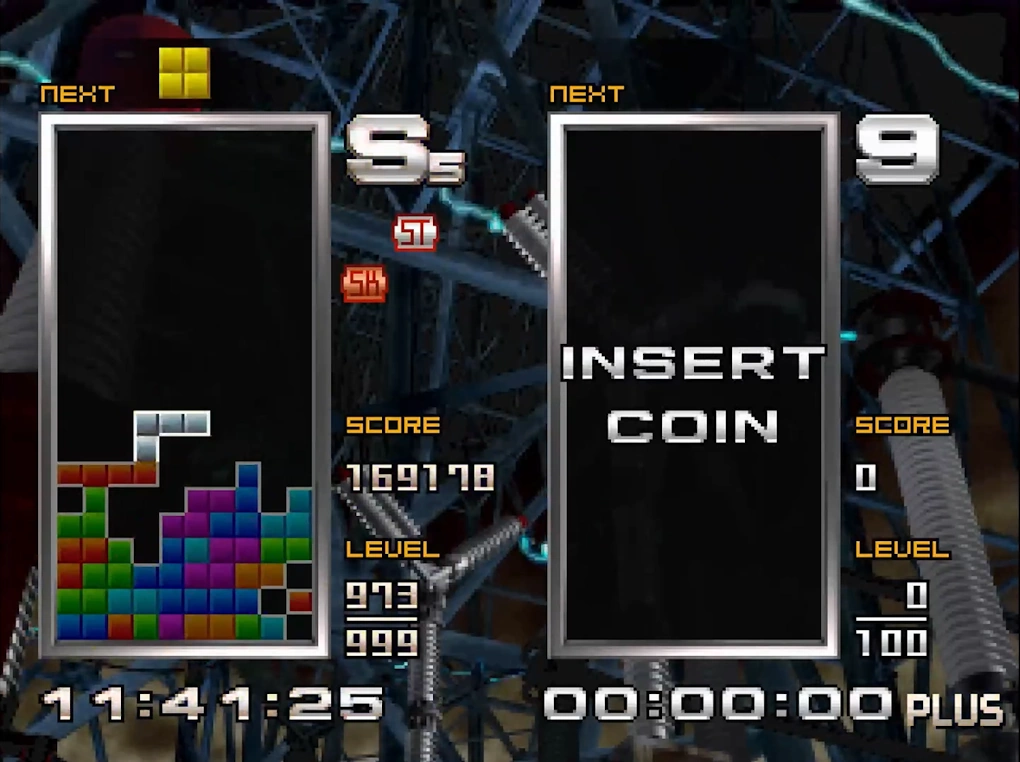 At level 900, the lock delay drops by nearly half, from 30 frames to 17. It becomes very easy for one misstep to result in a cascading error like this one, between the I-piece and the just locked L-piece. [src]
With this attention to detail and commitment to a high skill ceiling, TAP overcomes a typical hurdle with execution-based difficulty: the complexity and speed stresses players to the point where someone with hundreds of hours of play under their belt still makes mistakes. So many permutations of the stack exist that, even if the player builds to particular idiomatic structures, muscle memory will fail, especially if a given permutation only exists in a window of seconds or disappears completely on a given run. 20G, the highest speed, at least guarantees a restricted set of possible movement states on a drop, as the piece will instantly hit the stack. Players with muscle memory overfit to 20G will find themselves making costly mistakes in Master mode levels 300 - 500, where a handful of frames of dropping animation can ruin buffered movement. In many games, the player could solve these problems in a few hours of practice and move on; in TAP, problems can easily persist for the first 75 hours of play, if not more. Even as the second half of Master makes the curve more consistent, where the timings change solely on multiples of 100, some of the jumps will disrupt tempo of players not ready to rev up.
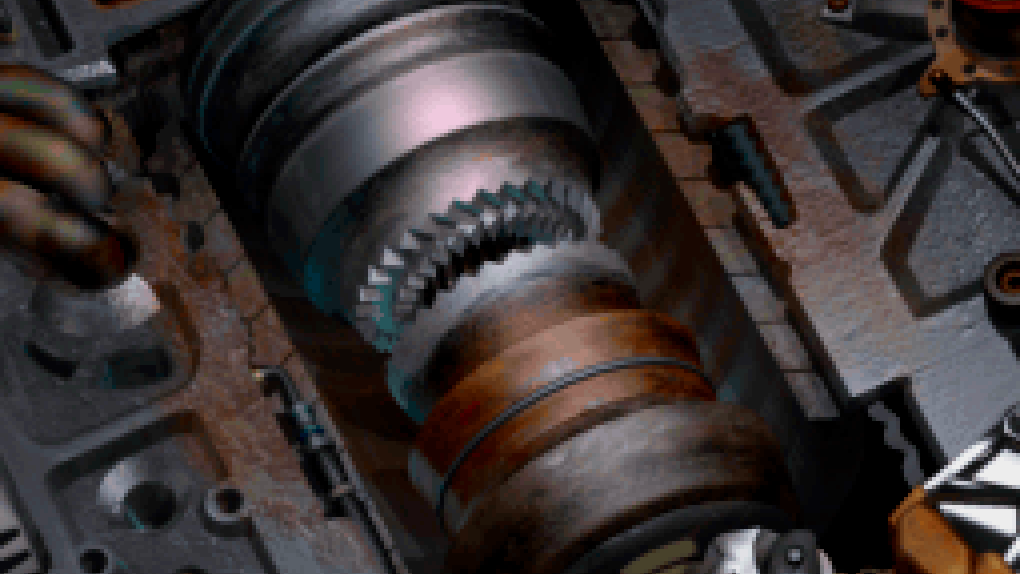
When the most painful jumps occur – especially at 700 and 900 – the music drops out completely, sometimes for over 20 pieces in a row. TAP is more than willing to conduct psychological warfare on the player when variables alone won’t push them off the cabinet. Everything about TAP’s presentation screams energy unexhausted, endlessly circulated for reasons unknown to the player. When 20G hits, the background turns to two crankshafts at negative phase with one another, with spaced-out rods loping, seemingly controlling pumps in cylinders that never reach maximum pressure. Meanwhile, in versus mode, two bulbous crown gears with multiple rows of teeth smash into one another, always in sync. To accent the discomfort, level 700 and on subjects the player to gabber, with a few dozen levels of obnoxious harmonica placed in front of high-pitched babbling.
-
Not that it necessarily matters in a survival context, but for the ranking system, where your rank perpetually decays and the top ranks have time requirements, spamming the easy singles won’t get you ahead. ↩︎
-
This article covers these different algorithms in great detail. Later games use variations on a system where a uniformly distributed set of pieces is generated, and pieces are pulled out of this set until it is emptied and a new one can be generated. TGM3: Terror Instinct is much more sophisticated but follows a similar premise. I’m not sure what TGM4: Absolute Eye uses; it has a version of the Guideline randomizer (“7-bag,” where only one of each piece is in the set) for one set of game modes and then a TGM-style one in its own modes. TAP is roughly identical to the first TGM as discussed in the article, but it rerolls up to six times to avoid respawning a block in the history rather than four times. ↩︎
-
More specifically, a piece that has not moved to a lower line, even if it has moved within the same line. ↩︎
Comments
You can use your Bluesky account to reply to this post.