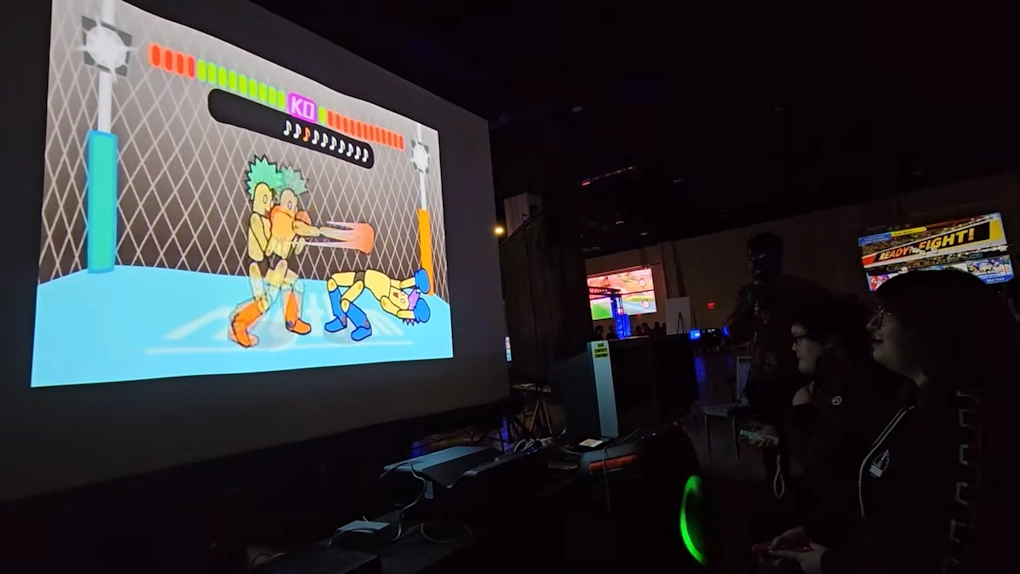
I’ve attended MAGFest six times now, and one of my favorite events each year are the tournaments. Regular head-to-head genres tends to monopolize the proceedings – fighting games, action puzzle games, TCGs, etc. – but they also put an emphasis on featuring less common tournament fare, including score-based games! In some cases this may be implemented through simultaneous play (a Typing of the Dead tournament I was in once was structured this way), but for others, the format allows everyone to watch each competitor play through a game superplay-style and mark their scores on a local leaderboard. I loved this concept so much that I started participating in online variants of the same concept with friends over the last two years, and it’s been a rousing success.1 My friends and I have played many more games off the beaten path, gained competency in the “prestige” titles, and explored some score systems that people rarely talk about. Below I’m going to offer a few reasons why an arcade club can be a benefit to your friend group and give some tips on setting it up and maintaining it.
Why Make a Club?
From my experience, participating in an arcade club has the following benefits to those interested in arcade clears and critique:
-
Most arcade emulation will give you either the default leaderboard or an online one: the former might give you next to no indication of what good score looks like at varying levels of play, and the online one will be absolutely massive, making contextualizing your own play a struggle. Curating a local leaderboard with peers lets you learn an environment with clear competitors that are (hopefully) close to you in skill level, and it makes incremental progress more meaningful in terms of climbing up the ranks.
-
Games with boring survival strategies may thrive in a scoring environment, and competing for score helps open up these dynamics. For instance, some of the Milestone shmups are oriented towards score mechanics so heavily that they actively ruin survival, such as Radirgy’s ABS Net, which seems like spammable invincibility and bullet-canceling in a survival context but is explicitly a multiplier-milking tool for score. We played Radirgy earlier this year and gained a new appreciation for it; it didn’t stop us from pushing single credits into the later stages either!
-
Games with short clears might have more meat on the bone for those willing to compete on score. One of our current events is Elevator Action, with three of us having achieved 1-ALLs in around five hours. Continuing to compete past an obvious clear point creates an incentive to learn how the game expands at higher levels of play.
-
Conversely, games with long clears may be unappealing, and competing in these helps establish markers of achievement that occur before the clear, such as placing top five in a leaderboard. Our other current event is The Fairyland Story, which is an obnoxiously long 100-stage clear that virtually none of us are willing to sit down with. Competing on score, we’re able to focus on the first 25 stages or so without concerning ourselves with pushing towards the clear. This also works for games that are extremely appealing but have steep learning curves, such as Spikeout or Battle Garegga, as participants can use the tournament to jump-start their practice and decide if they want to invest enough time in for the full clear afterwards.
Notes on Format
I’ve been part of two clubs over the last couple years: one of which I exclusively ran before handing the reins to someone else, and the other one of which I help out with occasionally. The former had much more structure, with a league points system (with an associated leaderboard) based on the top three winners of each tournament, and it interleaved score-based games with head-to-head games.2 We operated on a game nomination system, where nominees would be chosen in sets of three and voted on for each cycle. In the club I’m in now, which is much looser, a few of us assemble groups of games and vote on around seven at a time.
The former format appealed more to a bit of a “hardcore” crowd, but it also gets wonky when a given game has multiple leaderboards for it. Racing games we’ve tried like Daytona USA and other stage-based games like NiGHTS into Dreams work best with separate leaderboards for each stage, which can be aggregated using an in-tournament points system (again, with its own leaderboard) based on player rankings for individual stage. For a more casual group, like the one I participate in now, this level of scaffolding isn’t really a necessity at all. By this point I prefer the more relaxed approach, as it lets us end tournaments early if interest wanes, and there’s less jockeying for position for abstract points as compared to just getting times or scores on the board.
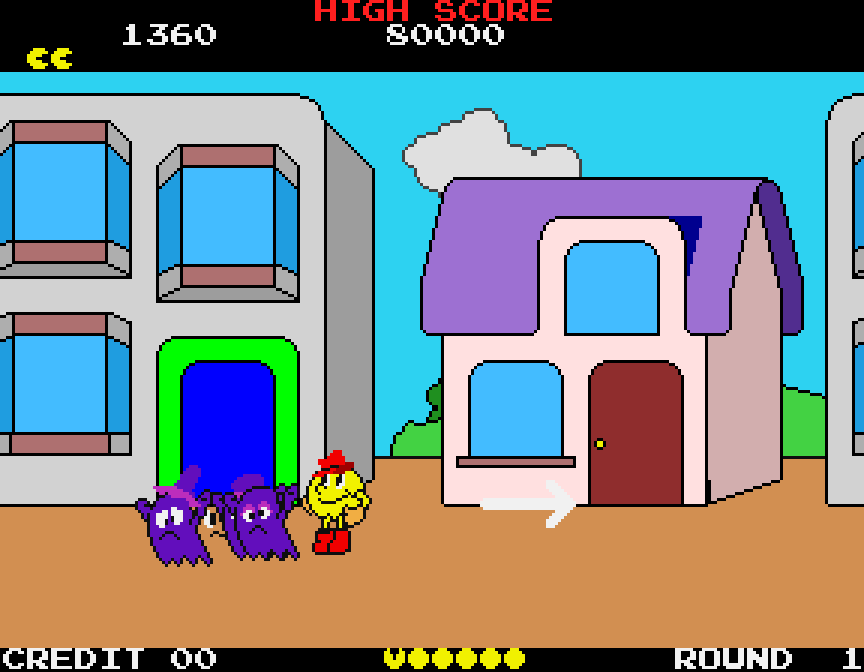 Pac-Land has a specific score-play opening where one manipulates enemies into two early clumps to gain Lucky Pac items, which give a massive bonus based on time remaining in the level. It’s perfect as a side game to learn the basics of, even if actually locking in for the full game isn’t appealing.
In my current club, we’ve been running two games at once for two weeks each, which has been surprisingly ideal for maintaining player interest. The perfect combination of games is a high-skill, beefy main event with a quirkier side event: probably the best example we’ve run so far is Super Monkey Ball alongside Pac-Land.3 In general, a modern + retro pairing seems to do the trick.
Pay careful attention to scoring dynamics for each given game before posting a leaderboard. In some cases, sorting the leaderboard by level before score encourages players to balance survival with score play, especially in games where milking exists. Watch some superplays on YouTube and read up on how scoring works. This is also why we’ve run a lot of racing games, since doing comparative time attack is relatively stable; you can’t really “gain time” in massive chunks or through repetitive, non-progressive actions.4
Think about using a dual achievement/leaderboard system that sets non-competitive goals as well. Crazy Taxi offers this intrinsically through its “license” system (ranks, basically) while also having a near-limitless scoring ceiling past the highest license. Having a sense of finality to an accomplishment like that is motivating in its own right: it feels pretty bad to jump to the top of the leaderboards one night only to wake up the next morning and find you’ve been dethroned, but no one can take a Crazy License away from you.
Finally, don’t stress too much if you get a couple games together and then some of the interest dissipates! Taking breaks for people to go off and play their own stuff makes it so that the next event can come back even stronger. If you have the wherewithal to pick it up again later, letting the club lapse for a bit can keep events from centering around a couple high-motivation people each time.
-
Public versions of this exist too, such as CAGTournaments and La Calice Cup. ↩︎
-
These alternated between fighting games and non-fighting games for diversity. Running these is more of a chore… I tried for quite a while to find an asynchronous system that would work for tournaments without ever settling on one. Usually the fire goes out relatively quick and matches slow to a crawl, especially outside of elimination formats, since people with less interest might only expect to play a game or two before washing out. In theory I would love to run month-long leagues for a game where we do a Swiss-format synchronous tournament every weekend and then total up points at the end (or do a round robin of the winners), but I’m less keen on doing the head-to-head stuff in general at the moment. ↩︎
-
Pac-Land has extremely idiosyncratic knowledge-check scoring related to warps and item spawns that made it fascinating to learn and completely acceptable to discard after putting up a decent score; the painful springboard mashing sections didn’t help either. Our current Elevator Action / The Fairyland Story combo has been ideal for similar reasons; the latter rewards stalling and rote AI manipulation on top of its length, so it’s gotten a few plays and plenty of discussion without distracting from the former. Our highest quality pairing has probably been Radrigy / Flicky, as the latter actually is rather elemental and intriguing in its own right. ↩︎
-
For games with actual time attack, anyway. Tall Twins Tower, for instance, subtracts seconds from the timer for certain actions, so it’s effectively a scoring system rather than true time attack. ↩︎
Comments
You can use your Bluesky account to reply to this post.