Trauma Center: Under the Knife
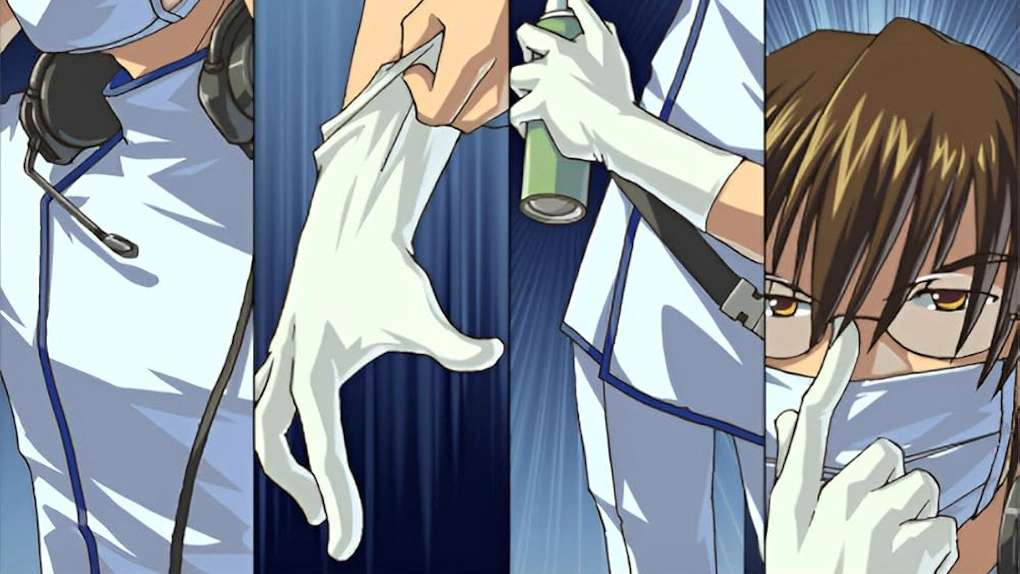
Atlus adapts the grisly world of surgery as a timer juggling exercise, with the player managing a main time limit, the drain on their patient’s vitals, and the interval until a new hazard spawns. Kyriaki, one of the game’s fabricated “GUILT” viruses, best exemplifies this. It appears by creating an incision in the patient’s tissue, which bleeds and thus increases the patient’s vital drain, and it travels under the tissue surface making more incisions until extracted. Locating one permanently requires detecting it with an ultrasound and then cutting it out of the tissue with the scalpel, after which it will make yet another incision, leaving two net additional cuts to deal with. To kill it, you target it with a laser for a period, with the caveat that leaving the laser in one place for too long will burn through the tissue and cause a hemorrhage. When multiple of these appear at once, you’re put in the uncomfortable circumstance of switching your attention between actively adversarial viruses and the injuries both you and they incur. This aligns with the game’s spatial aspect: your tools utilize stylus strokes, so the player can optionally bide their time fixing injuries while waiting for multiple Kyriaki to line up for extraction in a single strike. Attempting this without consideration of the patient’s vitals often results in a quick death, however, especially in scenarios where killing one on its own leads to two more spawning and overwhelming the organ with incisions. While this sounds like a traditional combat game, the implementation is a stranger blend: small skill-based actions, almost reminiscent of the exaggerated tasks of the Cooking Mama games, required dynamically based on the behavior of the virus.
Draining vitals isn’t a one-way street: two separate tools exist for increasing vitals in exchange for time. The primary one is the stabilization serum, which quickly raises vitals in correlation with the dose injected; the amount you raise the vitals scales with the amount of time raising the syringe’s plunger. Alternatively, the healing gel lightly raises vitals as applied by rubbing the screen in addition to healing non-laceration wounds. Both are limited resources that refill slowly when not being used or after a short lockout when they deplete, and alternating between the two becomes a natural tendency in the later operations when simply fighting the virus on its own can’t outpace the natural vitals drain. Later levels extend these limitations to other tools as well. The final boss Savato repeatedly locks out your scalpel when severing the spider-virus’s webs, and in its second phase, it spawns incessant mini-spider fodder. To defeat it, multitasking is mandatory between your vital gain tools and the laser, the latter of which must both proactively hit the virus itself and reactively clear the fodder. The best levels impose malleable rotations on the player, where multiple tools must be swapped as needed. These are rarely static, as the twitchy viruses and the wounds they inflict will keep the player weaving in defensive maneuvers dynamically. Learning this balance between offense and defense evokes the tension and precision of this fictional operating room.
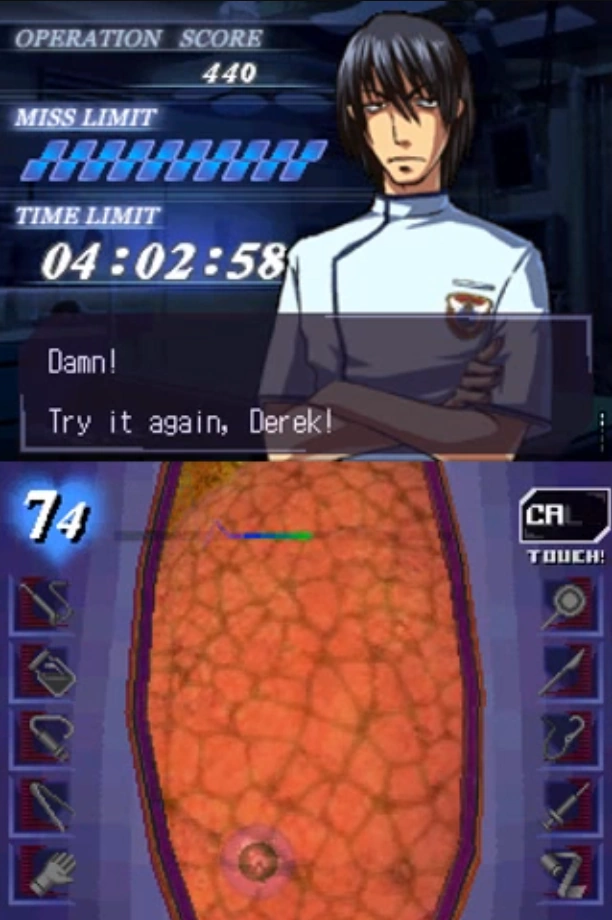 Individual operations are strung together with in-mission dialogue and visual novel-esque wrap-around segments. These provide escalation for viruses such as Pempti, shown here, which take the protagonists several separate attempts to eliminate. The narrative gets into rather melodramatic, fantastical territory, but in its own way it helps cut the edge off the nasty elements of opening live bodies. [src]
The level of creativity on display with the operations is also worth applauding. The latter half of the game (especially the endgame boss rush) begins to repeat itself, but earlier on the game is more than happy to give one-off operations their own bespoke mechanics, from attacking staggered clots traveling through winding veins to draining fluid from a man’s lungs on an airplane undergoing heavy turbulence. The game even switches to non-surgery elements just to keep things fresh, such as some hexagonal block puzzles and a mid-story bomb disposal. As with any game like this, duds rear their head as well. Two of the GUILT strains veer from the aforementioned formula for opposite reasons: Triti and its rules for cell expansion1 are poorly explained and mandate a specific solution that will jeopardize the operation with any single mistake. Conversely, Deftera depends on two viruses colliding in order to vacuum out of the tissue, and while its random movement can be manipulated by using the gel as a barrier, a good performance on these levels comes down to rolling lucky on getting good collisions back to back. Falling back on more of a puzzle approach as in the former example or mechanics out of the player’s hands as in the latter example can work when it’s a singular operation or a break from the action, but the repetition of their appearances makes their issues more noticeable.
-
It’s similar to Conway’s game of life. ↩︎
Comments
You can use your Bluesky account to reply to this post.