
The Layton series put itself in an unenviable position with a follow-up to the grandiose Unwound Future, which pushed the world-rending consequences of the series to their breaking point. Last Specter attempts to roll back to a more sustainable franchise template, both by starting a prequel trilogy and by restraining the scope to a small town with minimal personal entanglements for Layton, but in the process the writers lose the self-aware artifice that punctuated the previous entries. The original trilogy each features Layton traversing and overcoming a state of unreality;1 Last Specter expects both Layton and the player to take the game at face value. Misthallery has its charm, with canals threaded throughout, powered by a reservoir looming over the town, but what you see is what you get. The lack of mass conspiratorial orchestration leaves the new trilogy’s villain looking rather impotent compared to their predecessors, who possessed transformative power over the events Layton witnessed. When Last Specter’s narrative reveals the supposed titular specter – a giant figure that has destroyed swathes of the town – as a hitherto unseen squishy Loch Ness monster only to immediately hedge on its culpability, it inadvertently demonstrates just how lousy this game’s hand of cards is. Instead of bluffing until a flush is laid out at the end, they frantically stack bets on weaker reveals steadily throughout. Perhaps it improves the pace, but the final impact suffers.
Emmy, on the other hand, is a more conscientious attempt to round out Layton’s universe. She’s a sheepish apology for the botched integration of Flora in the original trilogy, whose status as a perpetual plot object nullified any attempt to build out her character. Emmy still gets upstaged by Luke just as often as Flora did, although his precociously ominous portrayal in a game designed to build out his backstory would be a difficult foil for any character to mesh with other than Layton. With the shift towards action that Unwound Future ushers in, Emmy additionally acts as Layton’s fists just as often as she contributes her brainpower, including in a solo jaunt at the halfway point to procure evidence in London. It’s a good attempt, but she’s still left flat, even when recounting the instigating event that led her to follow Layton, a relatively trivial event that mostly serves to exalt Layton’s uncanny investigative intuition. In a game where Layton returns to his disconnected roots after a turn towards the personal in Unwound Future, Emmy effectively ends up as a more impulsive duplicate of the man. She’s useful for the extensive side banter that the player can find dotted around each screen, but she adds little else.
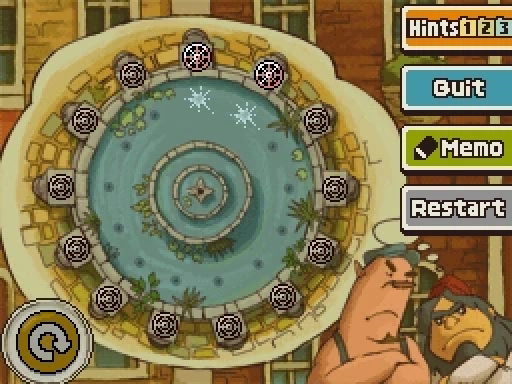 In the puzzle Fountain Fightin’, two men (with one controlled by you) alternate opening one or two consecutive spouts until someone opens the final spout and “wins.” Your computer-controlled opponent has already opened two at the top. By mapping the outcomes backwards, one can figure out the one configuration that will effectively checkmate your opponent to always cede the final spout to you. [src]
Regardless of the weaknesses of the story, the puzzle set actually continues to innovate over its predecessors. The implicit restrictions on deploying simple mazes and block-sliding puzzles feel even tighter than in Unwound Future, and this game takes the extra step of sundowning the frequent statement reconciliation puzzles, whether structured as “who told a lie?” or otherwise. Instead, Last Specter leans heavily into opaque pattern recognition and series derivation. At its most interesting, a puzzle will ask you to find a selection pattern of various objects such that a particular outcome is reached, such as removing varying numbers of wine bottles from a line to force an opponent to pull the final one; at its least interesting, obscure elements of a set of objects will somehow imply some pattern to apply to a final item, such as discerning archaic hieroglyphic languages, although even these stretch the brain past rote brute force. These coincide with a heightened focus on math puzzles: surprising amounts of geometry problems, counting series, and systems of equations. While the difficulty never obstructs, the lack of throwaway puzzles raises the floor noticeably, a welcome change from the padding that the prior games had.
At least, this is the case for the main puzzles; the minigames pull so heavily from Unwound Future that they’re scarcely worth mentioning. The new toy train set builds upon that game’s RC car tile-based navigation with the addition of your tail of railcars, and they become much harder to synchronize as a result. The pet fish, inversely, scales back the wonky physics of the parrot deliveries to something easily solvable, and the new puppet theater is an afterthought identical to the picture book. Instead, the most notable minigame has such a gravity that it must be accessed externally: Layton’s London Life, a dry run of what would eventually become Fantasy Life. Bizarrely, the game seems to graft the Layton characters to Mother 3’s engine,2 complete with flat-shaded sprites and diagonal-scrolling menu backgrounds. The concept seems to be boiling down JRPG conventions to such a point where combat ceases to exist, where the player avatar exists solely to absorb items into their personal black hole and increase their “happiness,” a nebulous entity that continually increases with virtually every action. Something akin to a plot exists here, but it’s effectively minute interactions between every Layton character, dead or alive, human or not, randomly spawning fetch quests or reminding you of the various fashion-related gatekeeping checks throughout the town. Beyond their endless prattling, London itself scarcely extends past a handful of screens, many of which are barren outside of specific events. It’s a shame that buried in here is a respectable juggling minigame that requires actual multi-tasking: you can launch the balls in the air to varying heights, which lets you desync their landing times with careful adjustment. Otherwise, the mode begs the question of how many man-hours were sunk into a project built to present a life unfulfilled.
-
Spoilers ahead, so I divided this out into a footnote. When I say “unreality” here I don’t mean it as an impression but literally that the settings of the first three games are false appearances. Curious Village’s St. Mystere is an autonomous puzzle fortress built to hide the creator’s daughter, Diabolical Box’s Folsense is overwhelmed with hallucinogenic gas that conjures its townspeople through exposure, and Unwound Future’s Future London is a gigantic replica built underneath the present city specifically to trap Layton. Not only do these fuel the series’ twists, but they contextualize Layton as more than an Agatha Christie-type character: he’s this seasoned traveler who calmly unravels baffling distortions of the world. Last Specter’s Layton regresses into just an amateur detective. ↩︎
-
Both that game and this side mode were developed by Brownie Brown. ↩︎
Comments
You can use your Bluesky account to reply to this post.