
Racing games often get boiled down to how turns are taken and how other cars behave, ignoring jargon-heavy descriptions of handling dynamics and transmission characteristics. Dotstream actualizes this: your “car” is merely a Tron-esque line that paints the lane behind it the same color. When you proceed straight on the horizontal track, you approach max speed, and when you arc into a different lane, you lose speed. Each line takes up the totality of its lane, so switching into an occupied lane skips your car to the next available, and course leaders can bump those trailing by hijacking their lane. Although you come out the gate exceedingly slow compared to your opponents, a slipstream mechanic evens things out. Shadowing a line by following in an adjacent lane juices a meter parallel to your speed; when this meter exceeds the other, it pulls top speed up to match. This interplay – clawing for lane space while hewing close to the front of the pack – defines Dotstream and its course design.
This is to say that, more accurately, Dotstream’s course design decides whether this tension exists. Its simplest obstacles – slowdown zones and impassable blocks – serve the fundamentals perfectly by necessitating lane changes. The former has the wrinkle of occasionally offering straight lines through clipped slowdown segments; on tracks with mandatory slowdown, the goal changes from avoidance to minimization. The latter causes potentially fatal crashes and provides the ultimate limitation on what lanes are available at any given point in the race, especially if you’re lagging behind and must make do with what’s available. Beyond this, other gimmicks stress the rudimentary AI to the point that outmaneuvering them becomes trivial. Each opponent uses pre-recorded routes as a baseline, and for tracks featuring boost pads or shortcuts, around half of the competitors will impede themselves by ignoring them entirely. When the obstacles start to move, many opponents will ram into them repeatedly, giving you the opportunity to focus on your own path lest you end up with the same fate as them.
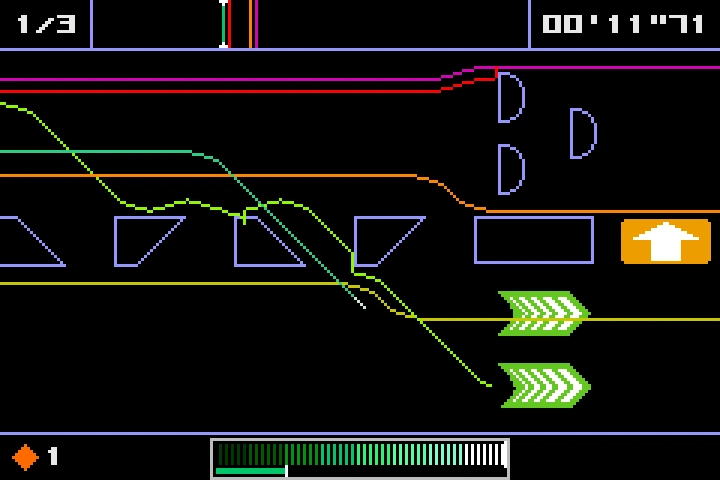 On Laser-3, the opening section stuffs the middle with sloped obstacles while alternating boost pads and half-circle obstacles on the top and bottom. In the first half, the optimal route asks players to weave through the trapezoids, while in the second half, they must hit the correct directional pad to avoid getting bounced back into their previous lane. As an execution test it’s legit, but as seen here, many of the opponents opt for less efficient paths.
If you find yourself too far back to catch up, you always have the option of expending one of your life points for a massive boost. This basic trade-off – putting yourself at a higher risk of retiring the race in exchange for a greater reward – doesn’t hold up under scrutiny when considering the mechanical limit. The courses are easily memorizable and the control surface limited to the point where, after a few replays with a comfortable route, cashing in on all of your health to ensure victory is near guaranteed. One little wrinkle makes it more interesting: stopping in the pit lane near the start gives you nine health/boost to work with, far exceeding the two you typically start with. Still, the mechanic adds no choices of consequence.
For each of the six grand prix you complete,1 you unlock a new ability for the “formation mode” in the main menu. This odd mode puts you in control of all six lines at once, starting with one and then building your ranks as energy thresholds are met. Energy pellets are scattered about a slow-moving infinite course, initially located in ways that require multitasking to wrangle lines on separate areas of the playfield. Once three lines come in, most of the pellets are arranged in a column, requiring only moving the set at once to grab them, and past four, obstacles progressively disappear as the mode transitions to a focus on spreading and contracting your line formation out at the right times. It’s only upon reaching six that you’re faced with a proper challenge: rotating the entire set of lines around your initial line in response to narrow chasms that will destroy the rest of your lines. These timing checks require coordination, but they stand alone overall, leaving potential obstacles on the table that could have required more sophisticated manipulation of the group. Still, the atmosphere changes from the abrasive breakbeats of the racing system to an emerging rainbow instead, underscored by quivering synth-strings and punctuated by timpani hits.
-
The final one, Tachyon, only unlocks when you have cleared every race from the first five GPs in first. Luckily, you can do this from the individual race select. ↩︎
Comments
You can use your Bluesky account to reply to this post.