
The kineticism of chiseling a sculpture out of stone infuses itself in any purely mechanical discussion; there’s no analysis of Picross 3D that can ignore it. In the original Picross games on Game Boy, the conceit was similar: the player chiseled images into a stone tablet. There, beyond the lack of a touch screen,1 the flat surface made the action less like a sweeping change and more like a small marking, like scraping one’s name into a wall. Here, the action transforms nondescript stone into a living, breathing object, releasing it from its marble cage and revealing its true form. Of course, the actual similarities to sculpture fall apart here: art doesn’t merely hide inside stone waiting to be systematically unveiled. But the tapping still translates to carving with force, presenting physicality many other DS games only wish they could have.
In practicality, a 3D nonagram reduces down into many 2D nonagrams all stuffed together into a layered model. If one were to solve any of the single nonagrams on their own with perfect information, as one would have in a 2D nonagram, then virtually no aspect of the third dimension would matter during play. This is especially an issue here with how small most of the individual nonagrams are: 10x10x10 puzzles don’t appear until the last few levels, and the 10x10 slices would be considered beginner-to-intermediate in most 2D Picross games. The solution, then, is to selectively remove hints on the side of the blocks to enforce consideration of the normal axis on any given layer. Many columns and rows lack a hint entirely, and with limited space to convey information, columns/rows with multiple groups of colored blocks have hints either circled or enclosed in a square, indicating that the number of blocks is separated into two or at least three groups, respectively. While this lack of information does make multiple passes through the layers orthogonal to either the X or Y axes mandatory, it also doesn’t necessarily create situations where one must actually consider the knock-on effects of a block’s coloring to other axes or layers.
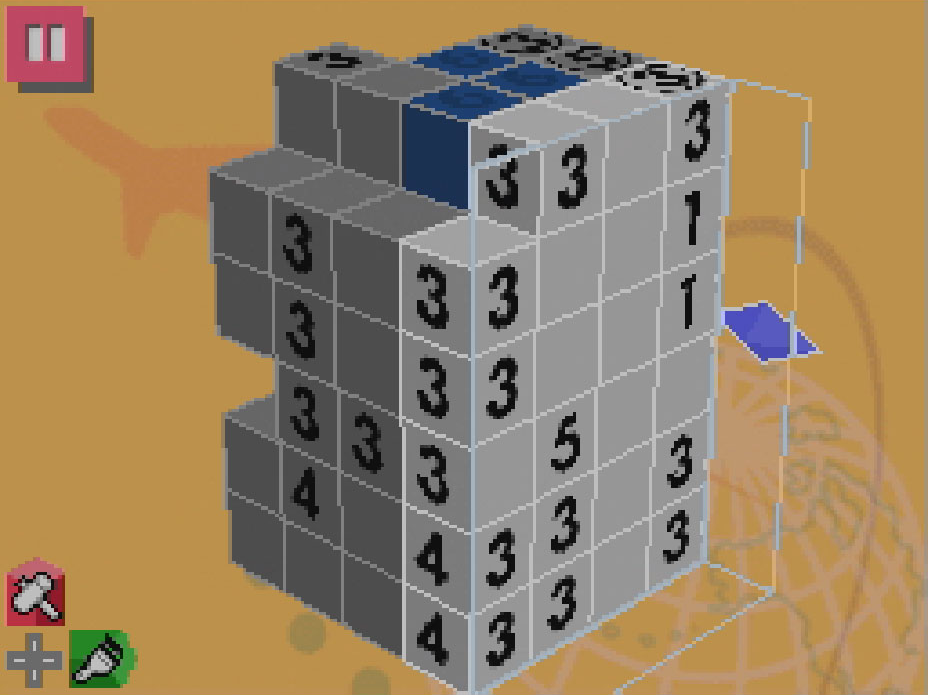 Diamond indicators on the X and Y axes let you isolate particular slices of the overall puzzle. By painting a block, you can track that it’s part of the underlying solution and prevent yourself from accidentally breaking it in the future. [src]
This results in a game that consists of cyclical iteration through each available layer, using the game’s built-in slice feature to isolate said layer and solve any puzzle restricted to its confines. Early in the game, where one is still wrapping their head around the idioms at play, this has its merits, but the game drags on for far longer than its difficulty curve can support. When the game does require an actual analysis of coloration across multiple layers, it seems like a design accident, often showing up in random puzzles rather than in the unlockable silver and gold puzzles or the final set of puzzles in the Hard difficulty. Situations where this occurs can often be mitigated by some careful attention to both the shape of the emerging sculpture and the probabilities of various outcomes. For the former, observing contiguity and symmetry often skips strictly following the hint system, although some puzzles drop little particles around the main sculpture body to throw the player off-guard. For the latter, knowing, for instance, that eight colored blocks exist in nine potential blocks in a column/row gives a good indication that hints perpendicular to them have an ~88% chance to work around a colored block in that location; if there’s only supposed to be a single colored block in that area, you can quickly clear a lot of chaff off of a smart guess.
-
There are, of course, other DS Picross games, but they had moved on from any framing beyond abstract tiles. ↩︎
Comments
You can use your Bluesky account to reply to this post.