
Players familiar with the effortless gear drifting of OutRun 2 may balk at the idea that it inherits much from the team’s prior Daytona and Scud Race titles, but common DNA threads through each one. Despite first appearances, OutRun 2 relies on the same exaggerated vehicle model: a strict power band, stiff handling at high speeds that frequently understeers, and drifts that linearly drain speed until exited. In the latter case, Daytona used engine braking to initiate drifts via holding a lower gear for a period of time before stabilizing the speed (which correlated with turn angle) by shifting back up. In OutRun 2, virtually every turn is solved with a plink across the shifter buttons, with little time spent in the lower gear. Instead, fine angle control is mediated through countersteer mechanics, letting the vehicle nudge laterally and alter the vehicle rotation angle on the fly. The choice makes OutRun 2 vastly more approachable at a glance, but a major change to the SP version brings back another Daytona mechanic for incredible flavor: slipstreaming.
As OutRun is effectively a series about the joys of grand touring,1 traffic plays a key role in each of the games, and it’s used to great effect in 2 to augment its slipstream mechanic. Vast periods of Daytona – outside of the Beginner track – feature few other cars assuming the player has broken out of the platoon at the head of the pack, making its slipstream mechanic more situational. Here, top speeds utterly depend on it. Up to 20 extra km/s gets added to the engine’s top-end power as the player approaches the rear of another car: the closer the player is, the more additional speed they’ll gain. Drifting in these situations has new interactions that augment this: as speed drain is linear during the drift, it actually has the knock-on effect of freezing speed after a slipstream is finished, as usually exiting the lane behind a car will clamp one’s speed back to the nominal limit. Additionally, drifting shields the player from the typical collision interactions, preventing one from losing speed during a bump. Even when drifting normally is easy, drifting during slipstreams in areas that don’t typically require them provides the edge that elevates a good player to a great one.
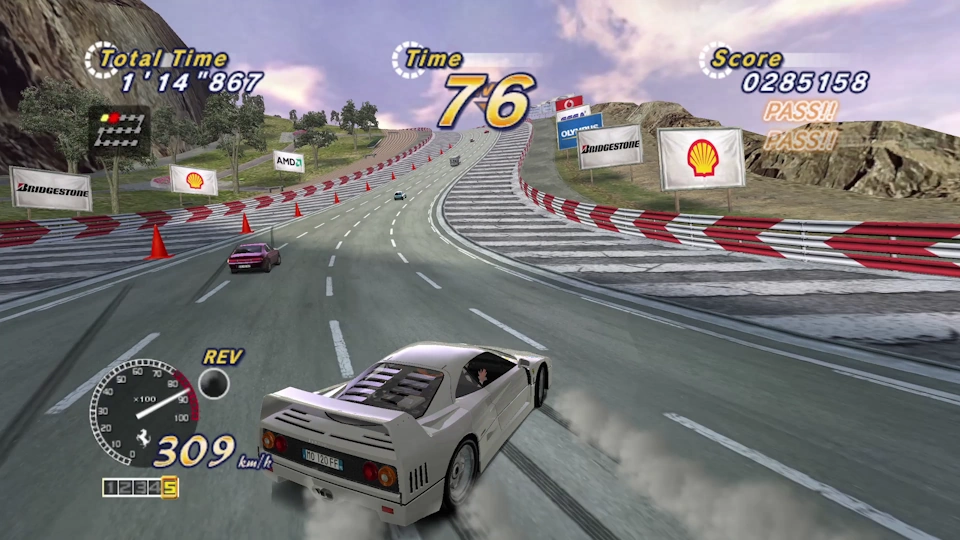 After a slipstream, the player can “freeze” their elevated top speed with a drift. Honing in on traffic to gain a slipstream right before a big turn is vital.
In a pure time-attack sense, the slipstreaming already has major implications on play: prioritizing the optimal line against maximizing speed through slipstreaming is an excellent source of dynamism thanks to the slight stochasticity of the traffic behavior. SP’s new scoring and “rivals” system elevates it to another level. Ambient score earned through moving forward is multiplied by 10 when at speeds only obtainable through slipstreaming, which is a simple incentive. However, additional score is gained by passing vehicles on the road, with an extreme amount of points (25,000) earned by overtaking rival Ferraris that spawn in each stage. If a vehicle is slipstreamed and then passed shortly after, then this value doubles, turning rivals into a 50,000 payday.2 In score play, weaving across the road to slipstream as many cars as possible becomes integral in way that disrupts the usual racing paradigm.
The rivals make up the bulk of the scoring experience despite this simply due to the gravity of their score bonus, and their behavior is rather strange. Theoretically, the rivals travel at similar speeds to the player, making them ideal slipstream candidates, as one can stay in the slipstream state behind them for longer before catching up and needing to pass. However, they seem to have a range surrounding them where they outpace the player until the player crosses the range. Once they have been “activated,” they become more docile, resting at speeds that make them approachable. Manipulating this pulls one out from the above elements, as minuscule variations in speed at certain points can create massive gaps between the player and the rivals, making extremely high top-speeds and careful line management more crucial in these areas. The problem lies less with the theory of the system – incentivizing the player to “lock-in” during particular sections instead of wildly slipstreaming everything3 – and more in its haphazard implementation, in the way that only certain rivals behave erratically under this system and, crucially, prevent the second rival of each stage from entering. In other cases, their more minute behavior swings things in the player’s favor, such as two rivals both swerving into the same transition area entrance when normally they should part ways.
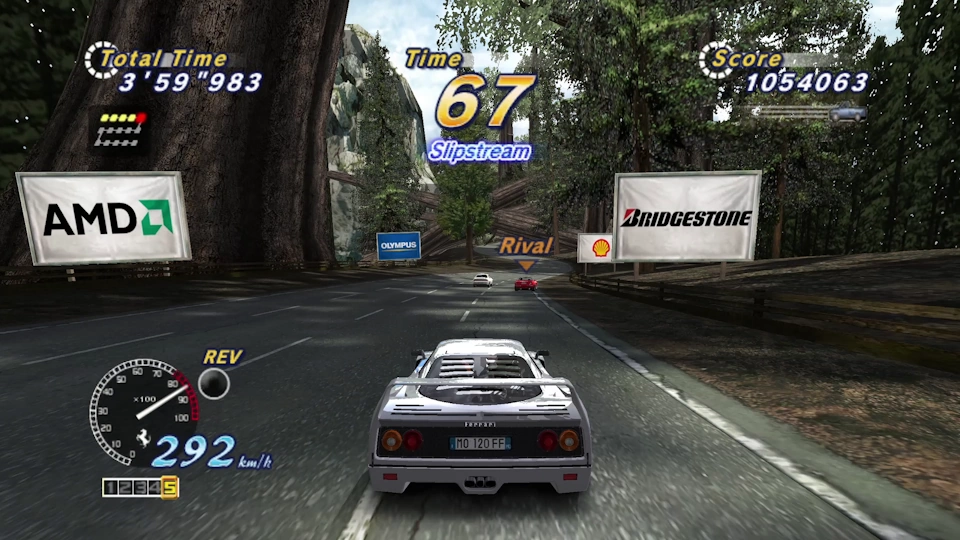 A final tour de force for AM2, OutRun 2 projects vicious scale in its blisteringly fast environments. Canopies of downed redwoods in the aptly titled Big Forest open up to snippets of a mountain view, shuttered by the monolithic conifers in its way.
Leaning into the scoring, as overtly rival-centric as it may be, spices up the majority of the game tremendously as, unfortunately, it strains the default drifting mechanics very little. The ease of drifting in the manual transmission mode turns at least half of the tracks across both of the primary maps into call-and-response drift checks, with prominent signs telling you exactly where each problematic turn is. The impetus isn’t necessarily wrong, since players can opt-in to harder content via the classic diverging routes at the end of each stage, but it does leave potential course designs on the table. Later levels introduce much tighter turns that clog the edges with obstacles or require re-drifts in the opposite direction, such as in the two hardest tracks in the SP map: Milky Way and Skyscrapers. The former has parallel snaking tracks, clogging the walls with hazard gates. The latter offers a more organic layout, looping U-turns into tight 90 degree exits between scenic jaunts through a downtown park. Both of these build much more of an inner narrative out of unique, challenging track design as compared to many of the others, which arbitrarily space turns away from each other and resemble artificial obstacle courses in the process.4
Those points at which the game cranks up the complexity of the turns helps emphasize the unique drift handling as compared to its forebears. For what OutRun 2 gains in wiggle room when adjusting mid-drift, it lacks in options for dialing in each drift, especially in multi-turn situations. In normal cases this encourages the player to play with the lateral movement and mid-drift turning for each curve, but it also implies the use of less conventional drift techniques. Although usually unnecessary, the drift is organic and initiable in a few ways, including through transient oversteer, slipping the back tires for a brief second. The physics of the drift initiation seem to take current slippage into account, as gear drifting immediately after an oversteer drift sends the car into a much tighter drift. This ability to re-drift for differing angles suffuses outside of this sole interaction into a sort of drift-maximal engine, goading the player into stacking drifts into narrow curves, elegantly snapping the car back to center by popping the throttle out, and reinitiating in the other direction.
-
The car selection is more on the upper-end sports car side, but OutRun 2 in particular pays homage to the era with cars like the Dino 246 GTS and the classic 250 GTO. ↩︎
-
Contacting a vehicle at any time before passing it will halve the value instead, irrespective of any slipstreaming. ↩︎
-
There are actual time/speed bonuses at the end of each stage, but these are easily the most opaque aspect of the scoring system. ↩︎
-
A couple other courses from SP I like (since I was grinding that the most recently): Jungle focuses in on compressed chicanes that gradually stretch out until the end, when a gigantic triple turn caps off the race. Casino Town only has a few turns, but I enjoy the extremely long U-turn upwards in the middle, which asks the player to maximize speed and maintain the line throughout the turn (and its setup) in a way most of the other courses don’t ask quite as directly. This feeds into the next obstacle – back-to-back inverted 90° turns at the end – without a way to quickly regain back speed, since traffic is light in the area between the two segments. ↩︎
Comments
You can use your Bluesky account to reply to this post.