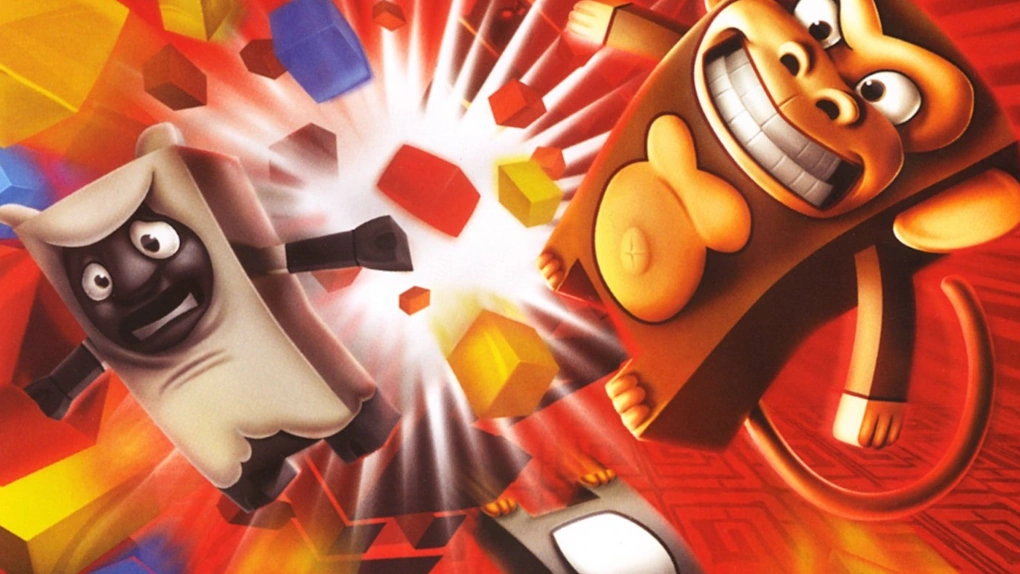
First perceptions may peg this game as a Jenga variant with some explosive addendums, but Boom Blox is more of a generic rigid-body physics sandbox with support for a diverse range of play-styles. This isn’t robust on accident, as the campaign explicitly pushes the engine’s capabilities to mold it around its scraps of narrative. Each level takes place in a flat, open zone with various stacked block structures, but the specifics beyond that can vary wildly, including the camera, which may be static, movable in an arc centered on the arena, or 360° rotatable from the playfield’s center. Players may lob baseballs, shoot guns, or manipulate the blocks depending on the course’s objectives. The Jenga comparisons apply to some levels, but in others destruction is an explicit condition, either in totality or in a controlled fashion. No matter what you choose, it’s rare that the game won’t throw you a curveball in one form or another.
The game’s basic “explore” mode reduces the game down to the core elements above and gradually ramps up the complexity of the model you’re preserving or destroying. Many of these levels revolve around score-infused blocks that add to a counter when they hit the ground or blue gem blocks that must all be removed to complete the level. It’s never as easy as just pulling the blocks out: often blocks must be carefully extracted with the blunt force of the baseballs, potentially colliding into other parts of the structure depending on the angle of the throw, while the true Jenga block removal is complicated by negative score blocks or living creatures residing on top, spelling certain doom if they hit the ground. To further strain the player, restrictions such as tight time limits or a limited reserve of baseballs encourages efficient play that leverages the physics to remove multiple critical elements from the playfield at once or leave everything resting on a single balance point.1
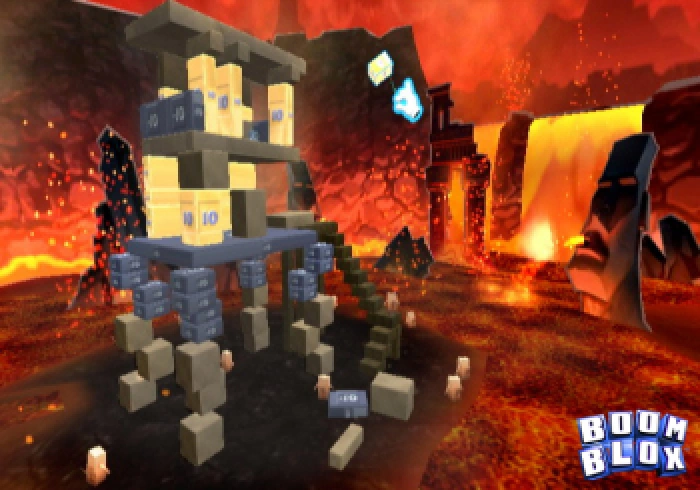 Flinging gold points blocks without disturbing their negative counterparts starts easy, but the rest of the structure has a tendency to knock the latter out of place. [src]
If the only external forces were your projectiles and gravity, the game would still be relatively limited; luckily, it’s instead loaded with additional block types that remedy this. The two main types are straight-up explosives, which ignite with enough force applied, and chemicals, which only ignite upon touching another block of the same type. The latter of these helps engineer trigger systems for an array of cannons, rockets, and minefields, helping the levels pivot into “find the one shot that makes the whole board collapse” territory. On the other end are vanish blocks, which instantly disappear upon being hit. This has the opposite effect to the others: rather than considering the blowback of moving a block non-ideally out of place and disrupting blocks around it, these let everything above them simply fall straight down, occasionally causing unexpected results in the process. Through this, they open up a different dynamic of sussing out hidden load-bearing spots behind them, creating a separate form of “find the one shot” with new physical characteristics.
Explore mode is complemented by “adventure” mode, which lightly contextualizes the challenges with narrative sequences starring the game’s rectangular animals. However, these animals begin appearing in the puzzles as well, autonomously pursuing objectives like stealing gems or chasing other creatures. The block structures here become less oriented around singular, rigid solutions to toppling them effectively and more oriented towards flexible resources that can obstruct, destroy, or corral creatures. Many levels swarm the playfield with creatures and let you attempt to keep them at bay from your gems with unlimited baseballs and/or movable structures, often with the blocks side being far too limited for the task alone. This can lead to selective obstruction, which is theoretically strong design for decision-making, but being able to pick off enemies just by deleting them with projectiles overwhelms the planning aspect and centralizes the missions around twitch gameplay.
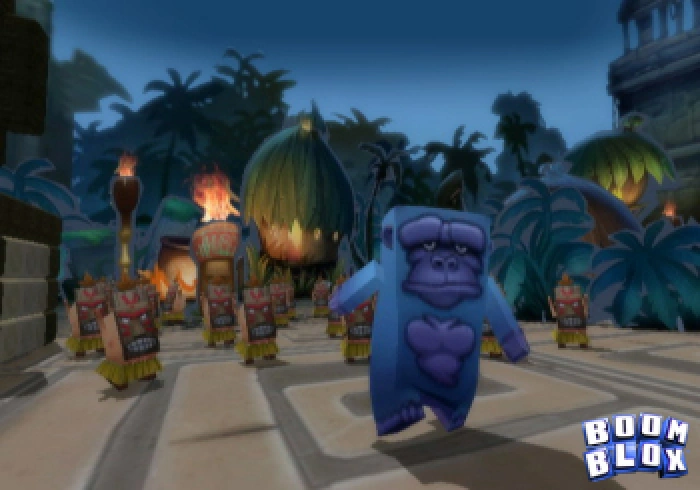 In one adventure scenario, a gorilla mother must be guided through a series of small mazes to rescue her children. These mazes are governed by gate walls that can be manipulated by dragging associated blocks locked into a series of rails, which manipulate the gates with referred motions. [src]
All of this leans on the Wii’s best control trait, the IR aiming, which necessitates some light-gun adjacent gameplay. Without a dedicated health system, the designers instead opt for variations on friendly creatures, fully susceptible to explosives or projectiles just as much as being assaulted by one of the enemies stalking them down or throwing bombs at them. These creatures may move throughout the level, making eliminating obstacles just as important as blocking enemies, or they may stay in place at the bottom of the screen, serving as a spatial health bar. This latter point has some interesting downstream effects: if one has already lost a creature on the left side of the screen, explosions on that side are now more likely to work in the player’s favor than they would had a creature still been in the vicinity; likewise, enemies spawned there now must redirect their movement or projectiles towards the other side of the screen, changing their movement/aiming patterns while also concentrating them on a single target instead of a spread.
-
The ranking system works around this as well: while sometimes bronze/silver/gold medals for a level are determined by score, just as often they’re determined by how many throws or movements were needed to complete a given level, depending on how the scenario is built. ↩︎
Comments
You can use your Bluesky account to reply to this post.