In Deus Ex, hour after hour of slices of the world perfectly align into a living playground of roving militants and hapless civilians. Rarely does a game ever make its missions feel properly explorable while keeping it taut and linear at the same time, and yet Deus Ex routinely weaves both together. For every underground lair with traps laid out in sequence, an open oasis follows – see the suffocating catacombs that give way to the Champs-Élysées avenue of Paris, with a bakery to pilfer contraband drugs from, a hostel with full bar access, and an arms dealer’s loaded apartment, all off the beaten path from your main objective. Military bases and science labs exhibit believable layouts, and locker rooms, rows of cubicles, and break rooms feature just as prominently in the dungeon crawling as warehouses with guards patrolling or tightly wound mazes of laser tripwires and turrets. The authenticity and legibility of these areas comes first, and yet more often than not the designers still manage to weave in appropriate challenges without violating each location’s fidelity in the process.
This dungeon crawling, despite first appearances, is ultimately the game’s design paradigm of choice. At least half of the game takes place in some sort of complex with a destination and a set of non-linear gates along the way, all of which serve as hinge points for the player to choose which resources to expend. The “ImmSim” label comes from just how many resources have gotten slammed together in your control: lockpicks and “multitools” for bypassing security, ammo for many different varieties of firearms, bio-energy for utilizing your augmented abilities, and a slew of consumables meant for tanking bullets, slipping past enemies, or breathing under water. At its tightest, the game puts some barrier and a way around it in your path, with the direct option being something like combat or picking a lock and the indirect option being finding a vent or waterway to circumvent the barrier. With enough of these situations back-to-back, the game hopes that you’ll avoid sticking to one gameplay style and preserve your resources for later when they seem more necessary; you can’t crack every door with lockpicks, so you’ll have to get your hands dirty or crawl on your belly occasionally if you want to keep your lockpicks for when the alternative is an irradiated death trap. While the fantasy works if you play into it, by endgame the resource economy completely turns in your favor, making decisions on resource expenditure past a certain point much more about cleaning out your inventory rather than rationing.
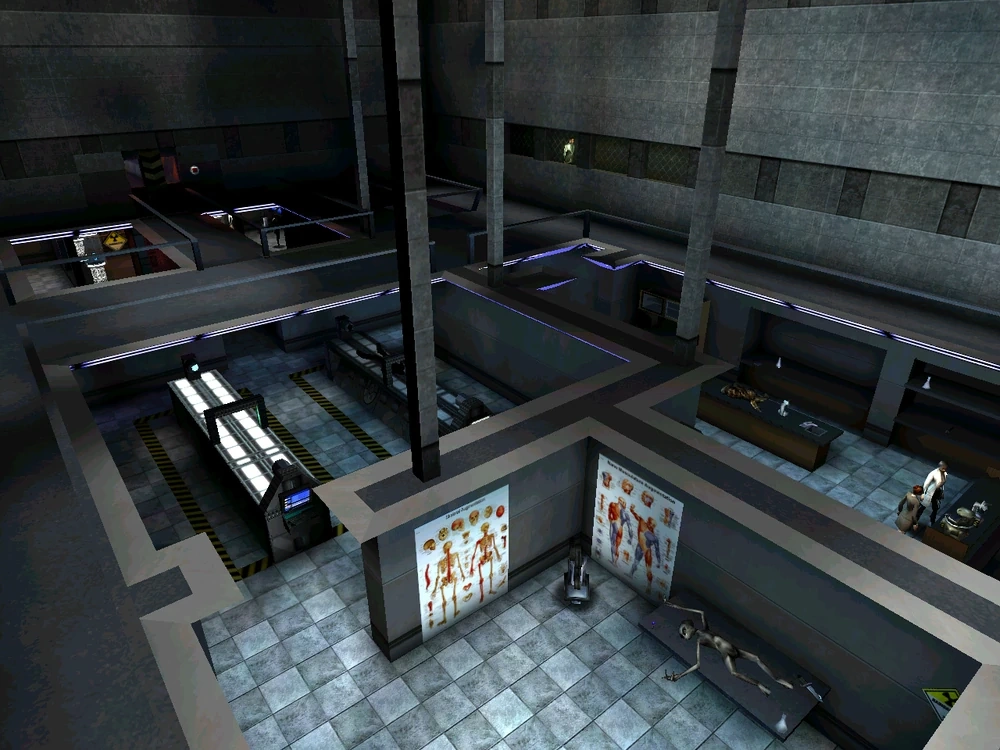 The Versalife facility places this two-layer laboratory area against many floors of hallways that snake up the side; rarely does any area in the game repeat a particular environment structure. [src]
When the game is firing on all cylinders, you’ll get something like Bunker III from the aforementioned catacombs. The area has two large rooms: the first has a camera and turret tracking you in front of a cell full of hostages, and the second has multiple floors connected by stairs with archways for cover. This leads to a back hallway swarming with rocket-strapped operatives where the camera/turret controls and a key to the next area reside; a waterway additionally connects the front of the first room with this back room. Here actual tradeoffs exist: one could grab the key and skip the whole area through the waterway, but the coverage in the back hallway is intense, and your direct path to the key is blocked by strategically placed crates as soon as you leave the waterway. Gunning for the security controls instead is feasible, and you can leverage the fact that hacking pauses enemies for a bit to quickly run out, disable everything, and hop back in the waterway. One could also sneak in from the front and use an augmentation to hide from cameras and avoid triggering the turret, and if you rescue the hostages with lockpicks instead of the cell key and leave the area early, you’ll get the next area’s key from their camp leader anyway. When the game constructs situations like these, they weave these tradeoffs into the actual second-to-second movement, stealth, and combat, making decision-making relevant at both micro and macro levels.
At its worst it’s the opposite: individual rooms with a guard or two and maybe a computer system or locked door stitched together by long hallways that isolate each scenario from one another. In these sections the main appeal is exploration, either through finding nooks and crannies hidden from view or by reading the many “data cubes” with flavor text strewn around. It can still be exciting, especially earlier on when you don’t have tools to detect enemies through walls and the suspense of moving around still persists. Later in the game, breaking apart puzzles by jumping over them with enhanced height, moving large crates to use as stairs with enhanced strength, or shooting down doors with a mastered rifle ability can potentially make the monotony less apparent. The barriers that can’t be stretched to be enjoyable suffer from lackluster implementation: the hacking, for instance, is more or less free even with minimal upgrades, and for every camera you have to actually maneuver around there’s at least four you’ll disable without thinking just because the security terminals are easy to access. If the mission locations didn’t adhere to the small details of real environments or didn’t have cute little secrets in vents and lock-boxes, these issues would likely overcome the holistic experience and result in tedium.
 Most of the NPCs in the game get moments in the spotlight, even ones as insignificant as these UNATCO troops. [src]
The tiny details extend further than objects in the world as well. From early on when one of your augmented colleagues begins spontaneously complaining about getting the wrong can of soda from a vending machine, high-quality NPC scripting persists to the final moments of the game, when a civilian mechanic distraught by protagonist Denton’s actions pulls a gun on him behind his back. The tight pacing of the levels allows for more opportunities for individual NPCs to have unique dialogue, behavior, and even inventory when subdued. Of these, the most fascinating to me may have been a conversation with a Chinese bartender in Hong Kong, who extolled the CCP’s commitment to capitalist enterprise outside the purview of the new world order by emphasizing authoritarian nationalism against Denton’s idealized western democratic order. It’s a remarkably sober, alarming view, and it’s reflective of the game’s almost non-ideological view of politics: people-facing organizations controlled by layers upon layers of shadowy organizations, each manipulating social behavior in a top-down way compared to bottom-up revolution and the presence of a cultural superstructure. Structurally precise as it may be, it also limits the game’s insight outside of vague gesturing to “control” and “liberty,” but the developers don’t take it too seriously, especially when Roswell-style grays begin showing up in the game’s final chapters.
Comments
You can use your Bluesky account to reply to this post.