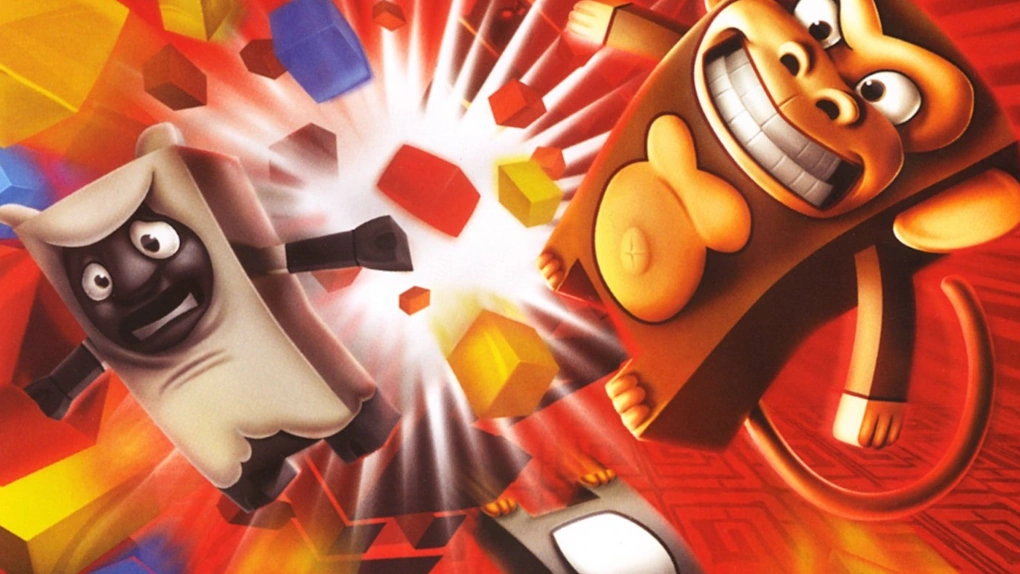
First perceptions may peg this game as a Jenga variant with some explosive addendums, but Boom Blox is more of a generic rigid-body physics sandbox with support for a diverse range of play-styles. This isn’t robust on accident, as the campaign explicitly pushes the engine’s capabilities to mold it around its scraps of narrative. Each level takes place in a flat, open zone with various stacked block structures, but the specifics beyond that can vary wildly, including the camera, which may be static, movable in an arc centered on the arena, or 360° rotatable from the playfield’s center. Players may lob baseballs, shoot guns, or manipulate the blocks depending on the course’s objectives. The Jenga comparisons apply to some levels, but in others destruction is an explicit condition, either in totality or in a controlled fashion. No matter what you choose, it’s rare that the game won’t throw you a curveball in one form or another.
The kineticism of chiseling a sculpture out of stone infuses itself in any purely mechanical discussion; there’s no analysis of Picross 3D that can ignore it. In the original Picross games on Game Boy, the conceit was similar: the player chiseled images into a stone tablet. There, beyond the lack of a touch screen,1 the flat surface made the action less like a sweeping change and more like a small marking, like scraping one’s name into a wall. Here, the action transforms nondescript stone into a living, breathing object, releasing it from its marble cage and revealing its true form. Of course, the actual similarities to sculpture fall apart here: art doesn’t merely hide inside stone waiting to be systematically unveiled. But the tapping still translates to carving with force, presenting physicality many other DS games only wish they could have.
Racing games often get boiled down to how turns are taken and how other cars behave, ignoring jargon-heavy descriptions of handling dynamics and transmission characteristics. Dotstream actualizes this: your “car” is merely a Tron-esque line that paints the lane behind it the same color. When you proceed straight on the horizontal track, you approach max speed, and when you arc into a different lane, you lose speed. Each line takes up the totality of its lane, so switching into an occupied lane skips your car to the next available, and course leaders can bump those trailing by hijacking their lane. Although you come out the gate exceedingly slow compared to your opponents, a slipstream mechanic evens things out. Shadowing a line by following in an adjacent lane juices a meter parallel to your speed; when this meter exceeds the other, it pulls top speed up to match. This interplay – clawing for lane space while hewing close to the front of the pack – defines Dotstream and its course design.
Atlus adapts the grisly world of surgery as a timer juggling exercise, with the player managing a main time limit, the drain on their patient’s vitals, and the interval until a new hazard spawns. Kyriaki, one of the game’s fabricated “GUILT” viruses, best exemplifies this. It appears by creating an incision in the patient’s tissue, which bleeds and thus increases the patient’s vital drain, and it travels under the tissue surface making more incisions until extracted. Locating one permanently requires detecting it with an ultrasound and then cutting it out of the tissue with the scalpel, after which it will make yet another incision, leaving two net additional cuts to deal with. To kill it, you target it with a laser for a period, with the caveat that leaving the laser in one place for too long will burn through the tissue and cause a hemorrhage. When multiple of these appear at once, you’re put in the uncomfortable circumstance of switching your attention between actively adversarial viruses and the injuries both you and they incur. This aligns with the game’s spatial aspect: your tools utilize stylus strokes, so the player can optionally bide their time fixing injuries while waiting for multiple Kyriaki to line up for extraction in a single strike. Attempting this without consideration of the patient’s vitals often results in a quick death, however, especially in scenarios where killing one on its own leads to two more spawning and overwhelming the organ with incisions. While this sounds like a traditional combat game, the implementation is a stranger blend: small skill-based actions, almost reminiscent of the exaggerated tasks of the Cooking Mama games, required dynamically based on the behavior of the virus.
The Layton series put itself in an unenviable position with a follow-up to the grandiose Unwound Future, which pushed the world-rending consequences of the series to their breaking point. Last Specter attempts to roll back to a more sustainable franchise template, both by starting a prequel trilogy and by restraining the scope to a small town with minimal personal entanglements for Layton, but in the process the writers lose the self-aware artifice that punctuated the previous entries. The original trilogy each features Layton traversing and overcoming a state of unreality;1Last Specter expects both Layton and the player to take the game at face value. Misthallery has its charm, with canals threaded throughout, powered by a reservoir looming over the town, but what you see is what you get. The lack of mass conspiratorial orchestration leaves the new trilogy’s villain looking rather impotent compared to their predecessors, who possessed transformative power over the events Layton witnessed. When Last Specter’s narrative reveals the supposed titular specter – a giant figure that has destroyed swathes of the town – as a hitherto unseen squishy Loch Ness monster only to immediately hedge on its culpability, it inadvertently demonstrates just how lousy this game’s hand of cards is. Instead of bluffing until a flush is laid out at the end, they frantically stack bets on weaker reveals steadily throughout. Perhaps it improves the pace, but the final impact suffers.
The usual action-puzzle title, hopelessly indebted to Tetris, builds upon a grid-based playfield with game elements falling from the ceiling; Digidrive ignores this, with elements appearing at four points and drifting smoothly down two perpendicular lanes. 1 These elements, of three colors, are abstract vehicles crossing through an intersection, where the player redirects them using the d-pad. These cars stop once they reach a spawn point and stack with like colors; if a different color approaches, the cars previously stationed there will reverse course and return to the intersection. Stacking five cars at a spawn transforms it into a fuel cell for that color, although it disappears if not supplied regularly with more cars of the correct type, the timer for which inversely scales with the amount of fuel.
Tucked away on the official AARP website – the acronym formerly stood for “American Association of Retired Persons” – is an oasis of small arcade-style games; browser experiences perfect for an aging audience uninterested in metaprogression or buildcraft. Of these, Ballistic encapsulates the style: it reframes Breakout as turn-based actions, where the player shoots a stream of balls that ricochet off of walls and destructible blocks, waiting for each ball to land back at the bottom before firing the next volley. Instead of separate levels with fixed arrangements, all the blocks in the playfield shift down one row in an implicit grid after each turn, with the game ending when a block reaches the line the player shoots from. At the same time, a new row of blocks appears one row below the top, with at least one gap left for the player to sneak their shots in. Over time, this breaks the playfield up into two sections: dense blocks at the top, and stragglers creeping towards the bottom on every turn. A smart shot attempts to clean up both areas by trapping balls in a cave on the always empty top row behind multiple rows of blocks. Doing this while having the balls trickle down to the bottom section as they exit the cave keeps the playfield clean. Additional wrinkles prevent this loop from staling: ball pick-ups add to the number you shoot on every turn, and the “health” of the blocks (how many hits they can take before breaking) scale alongside your reserve, occasionally throwing in double-health blocks to ensure that some blocks actually survive down to the second layer. The simplicity of these aspects, the intuitive physics system, and a prominent scoring system (the game’s only goal, with a leaderboard prominently displayed) demonstrate why even nondescript browser games can still showcase the elegance of the medium.
Command-line interfaces are less a mystic channel of communication with an operating system and more a compromise. Writing graphical interfaces is difficult and time-consuming, and for the average developer, it’s much easier to implement text-based commands than get mired in the widgets, frames, and event-driven programming that comes with GUI creation. However, a CLI is also enticing for how easy it is to enable cooperation between different applications using a common set of commands: piping, redirection, and a slew of helper programs all support a robust level of control for the user.
Having soldified their position at the top of the “experimental” commerical gaming heap in Japan, NanaOn-Sha were able to let their hair down with PaRappa 2, moving past the idyllic picture-book narrative of the original game in the process. What this presents as is split between two equally disconcerting plot threads: the first a militaristic invasion of PaRappa Town by noodle enthusiasts, prompting late-game armed resistance by the protagonists, and the second a quest by PaRappa to be come a more “mature” lover. Look no further than Master Onion in a sleazy red tracksuit instructing PaRappa through the TV on his brand of romantic gestures (still mostly related to karate) as PaRappa tries them out on his enthusiastic best friend PJ.1 Interspersed are scenes of PaRappa and his girlfriend Sunny’s respective fathers scrambling around on the ground, having accidentally shrunk from one of PaRappa’s dad’s inventions. The developers assuredly understand how ridiculous the scenarios are now, even compared to the off-kilter Um Jammer Lammy, and they sprinkle in non-sequiturs and little gags to add extra flair, from Master Onion going on a tangent about his legal problems to primary antagonist Colonel Noodles dropping nasty innuendo.2 Even when they’re not necessarily going for a laugh, the stages still draw the player’s attention with dynamic visuals, such as with a galactic PaRappa looming over the earth during the even verses in the song Big.
Goemon is clinging onto that 1997 release date for dear life: it gets plenty of points just for implementing a serviceable 3D Zelda template before Ocarina of Time dropped. Even extending the timeline out to the end of the fifth generation, it’s rare to see games on these consoles attempt a relatively explorable world. Of course, what qualifies as a “vast” depiction of feudal Japan here (lovingly depicted by the map screen) ends up being extremely large, box-y rooms peppered with weak enemies and occasional flora. Konami’s design here fluctuates between purely functional point-A-to-point-B shuffling and attempts to capture the essence of grand vistas, if not its contents. Where the barren mountainsides and fields lack character, the towns make up for it, featuring denser landmarks and humorous NPCs. This works in Goemon’s favor as well, as the relaxed pace and silliness, punctuated by compressed canned laughter, keep the landscapes from having to summon wonder when they’re unable to do so; it’s merely a bonus when they add substance to the gaps in the humor. Some of these arise from unlikely places: at the end of the Festival Temple Castle, a pole of massive koinobori – fish-shaped windsocks – sits in front of a waterfall, dwarfing Goemon and his friends by multiple orders of magnitude. The experience of climbing up the koinobori, rotating stiffly around the pole, looms large with its vertical scale, making one feel minuscule in the face of it.